In this article
People often choose a divination method by asking which one will give the clearest answer.
Tarot is selected when a decision feels urgent. Astrology is chosen when the question concerns personality, compatibility, or timing. A newer system may be expected to do both at once, as if every method were competing to provide the same answer with greater accuracy.
For example, someone may be uncertain about a relationship that has recently become difficult to read. Messages still arrive, but less often. The warmth has changed. Nothing has been clearly ended, yet nothing feels secure.
A tarot reading might be used to ask what is happening between the two people right now. The cards may draw attention to hesitation, avoidance, hope, emotional distance, or a choice that has not been openly discussed.
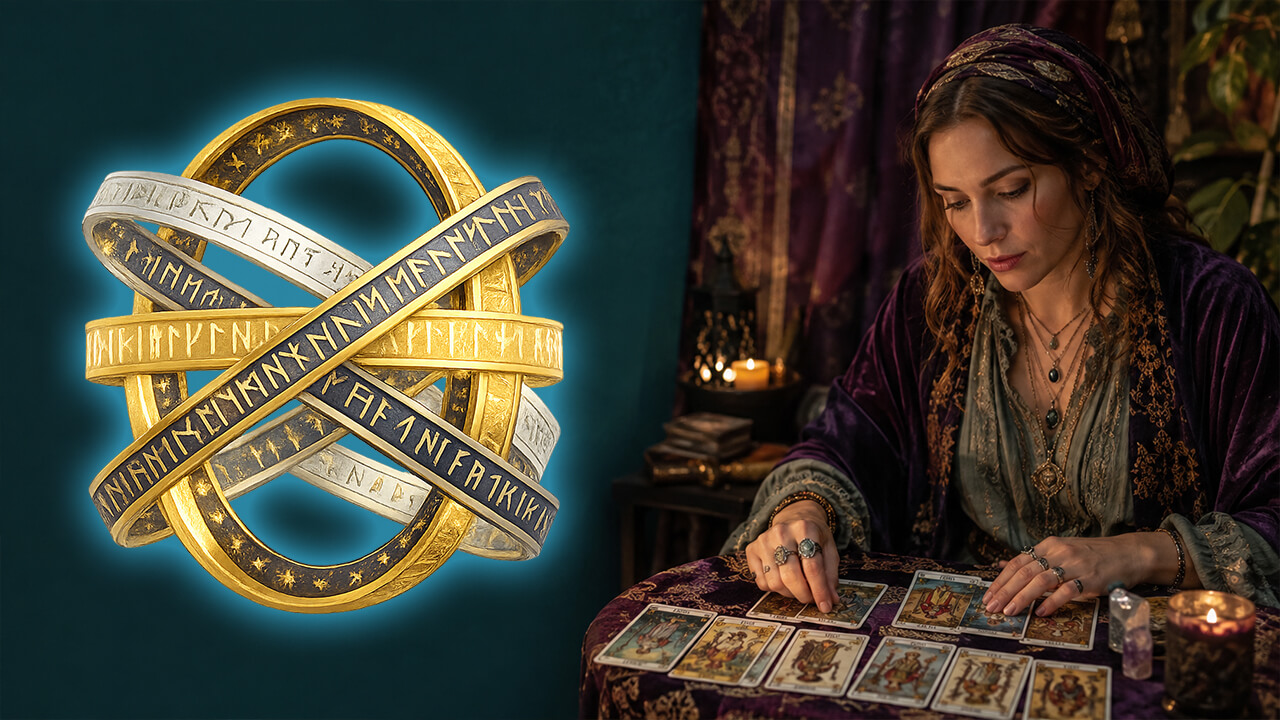
A Sixteen-Ring reading begins somewhere else. It looks at the person’s recurring structure. How do they react when closeness becomes uncertain? Do they press for an answer, monitor every change in tone, keep several interpretations open, or hold onto the relationship because familiarity feels safer than change?
Both readings can be meaningful.
The burden begins when they are expected to provide information they were not designed to provide. A tarot card is treated as proof of another person’s private intention. A personality type is treated as a prediction of what will happen next.
The difference is not that one method reads the truth while the other reads feelings. They begin with different material, and they organize uncertainty in different ways.
The first place to look is what each method is actually reading.
They Begin With Different Sources of Information
Tarot begins with a question, a draw, and the symbolic relationship between the cards that appear.
The question may be specific. Should I contact this person again? What am I overlooking in this job decision? Why does this conflict keep returning?
It may also be open. What deserves my attention right now?
The cards are placed within a spread or read in sequence. Their imagery, traditional associations, positions, and relationships create the material for interpretation. A card that suggests withdrawal can take on a different meaning beside a card associated with conflict than it would beside one associated with recovery.
The reading belongs to that draw.
Ask the question again at another time, and different cards may appear. That does not automatically mean the first reading was wrong. The person’s attention, emotional position, circumstances, or available choices may have changed. Even when very little has changed externally, the second reading may expose another side of the same issue.
Tarot is responsive in that sense. It meets the question where it is being asked.
Sixteen-Ring Divination begins with birth data.
The birth date is used to identify a stable symbolic type through the system’s numerological structure. The result belongs to one of sixteen insect types and one of four broader groups: Active, Harmony, Motion, or Presence.
The structure also includes a Type Element, a Mercury or Venus orientation, a Sun or Moon mode, and an Outer or Inner Ring position.
These parts are assigned different jobs.
The Type Element describes the main driving quality. Fire tends toward initiation. Water begins through reception and adjustment. Air works through thought, connection, and changes in perspective. Earth emphasizes continuity, judgment, and what can be maintained.
Mercury and Venus describe where experience tends to become understandable first. Mercury-oriented types often begin with information, language, observation, and judgment. Venus-oriented types begin closer to values, sensitivity, attraction, comfort, and relationship.
The Sun and Moon distinguish a more established outward expression from a more responsive inward one. This is reflected through the Outer Ring and Inner Ring.
The same birth date should not produce a different basic type because the person is asking about love instead of work. The topic changes. The structural foundation does not.
Astrology is added as another layer. The horoscope describes the broader celestial conditions of a particular period. The Celestial Proximity Rate is used to consider which planetary symbolism is more likely to resonate strongly with the person or type within those conditions.
That distinction matters.
Tarot generates a new symbolic arrangement for the question being asked. Sixteen-Ring Divination starts from a stable calculated structure and applies it to the question.
One reading begins with the present draw.
The other begins with the person’s recurring pattern.
Tarot Reads the Live Question More Directly
Tarot is especially useful when the question itself is still taking shape.
A person may believe they are asking whether they should accept a new job. Once the cards are placed, the stronger issue may appear to be fear of disappointing the person who helped them get their current position.
The practical decision remains.
The emotional center of the decision has shifted.
This is one of tarot’s strengths. The symbols can interrupt the explanation the person arrived with. A card may bring attention to a feeling, contradiction, or possibility that was not included in the original question.
The reading does not need a complete biography to begin. It can work with the situation that is active now.
Suppose someone asks why a new relationship has become tense.
A tarot spread may focus on what each person is bringing into the current exchange, what is being avoided, what is being assumed, and what direction the relationship is taking if the existing behavior continues.
That last point should be handled carefully.
Tarot can describe the apparent direction of a pattern. It should not turn that direction into an unavoidable future. A card showing distance does not prove that a breakup has already been decided. A card associated with reunion does not confirm that another person will return.
The cards create material for reflection.
They do not provide access to facts that have not appeared in the relationship.
Tarot can also be useful when someone understands their usual pattern but still cannot see the current decision clearly.
They may already know that they avoid confrontation. The unanswered question is whether this particular conversation should happen now, what they are afraid it will change, and which part of the situation they have been refusing to name.
A card reading can stay close to that moment.
It can examine the difference between waiting because more information is needed and waiting because the answer may be uncomfortable.
Tarot also allows chance into the reading.
The reader does not choose the card that best supports the person’s existing self-image. An unexpected image appears and has to be considered. That can be valuable when someone has repeated the same internal argument so many times that every familiar thought now leads to the same conclusion.
The randomness of the draw does not make the interpretation automatically true.
It creates a disruption.
The person is given another symbolic angle from which to see the issue.
Sixteen-Ring Divination is less dependent on that kind of disruption. Its value comes from continuity. The same underlying coordinates can be revisited across several areas of life.
Tarot asks, “What is active in this question now?”
Sixteen-Ring Divination asks, “What recurring structure is meeting this question?”
Sixteen-Ring Divination Shows Why Similar Situations Keep Returning
A current problem rarely arrives without history.
The unanswered message is new. The reaction to it may be familiar.
The workplace conflict involves different coworkers. The role the person assumes may be almost identical to the role they carried at their previous job.
Sixteen-Ring Divination is designed to notice that repetition.
An Active type may repeatedly become the person who moves first. They start the conversation, make the decision, or take control when everyone else hesitates.
That ability can be useful. It can also create a life in which the person is surrounded by people who wait for them to act.
A Harmony type may notice discomfort before anyone speaks. They adjust their tone, reduce tension, and make room for other people’s needs.
Over time, they may become so skilled at preserving the relationship that their own response appears only after resentment has formed.
A Motion type often sees another possibility. They can prevent a narrow decision and introduce a perspective the group has missed.
The burden appears when keeping options open becomes safer than accepting the consequences of one choice.
A Presence type protects what has been built. They value continuity, reliability, and structures that can survive beyond the first period of enthusiasm.
The same strength may keep them maintaining a relationship, job, or routine that stopped supporting them long ago.
These patterns do not predict one event.
They explain why different events may produce a recognizable response.
The Outer and Inner Rings add another distinction. Outer Ring behavior is easier for other people to see. Inner Ring activity may be intense while remaining private.
An Outer Ring person may appear to be doing all the work in a relationship because they initiate the conversations and make the plans. An Inner Ring person may be monitoring every emotional change while saying very little.
The reading can identify the mismatch between visible effort and private effort.
It still cannot declare both forms equally healthy.
Private concern eventually needs a form the other person can understand. Visible effort needs to leave room for another person to participate.
The Mercury and Venus orientations can explain another repeated misunderstanding.
A Mercury-oriented person may respond to uncertainty by asking more questions. They want the issue named and the decision made clear.
A Venus-oriented person may notice the emotional change before they have language for it. Repeated requests for an explanation can make them feel pressured at the exact moment when they need enough safety to understand their own response.
Neither orientation is better.
The problem begins when each person assumes that their own sequence is the responsible one.
The Mercury-oriented person believes clarity must come first.
The Venus-oriented person believes the emotional conditions must change before honest clarity is possible.
Tarot may show that this tension is present in a particular conversation.
Sixteen-Ring Divination explains why the same tension is likely to return in other conversations unless the underlying sequence becomes visible.
That is its main territory.
It reads the architecture behind the moment.
Neither Method Should Be Used to Manufacture Certainty
The easiest way to blur the difference between tarot and Sixteen-Ring Divination is to ask both methods to prove something about the future or another person.
A tarot reading cannot verify that a partner is faithful.
A Sixteen-Ring compatibility result cannot verify it either.
Tarot cannot prove that a delayed reply means rejection, emotional overwhelm, another relationship, or an ordinary practical interruption.
A Sixteen-Ring type can show how the person receiving the delay is likely to react. It cannot identify the private reason behind the other person’s silence.
Both methods can describe patterns around a decision.
Neither should replace evidence.
This limit also matters in career questions.
Someone can ask tarot what they are overlooking in an offer, what fear is shaping the decision, or what the current path seems to require from them.
A Sixteen-Ring reading can show the working role they repeatedly assume, the environment that supports their abilities, and the conditions under which a strength becomes exhaustion.
Neither method can guarantee a salary, promotion, or successful business.
The practical information still matters.
What does the contract say? Is the income sufficient? What authority comes with the responsibility? Is the working environment safe? Does the person have the resources required to leave?
A symbolic reading should make those questions sharper.
It should not make them disappear.
The same applies to health, legal problems, money, and mental health. Tarot and Sixteen-Ring Divination are interpretive tools. They are not substitutes for qualified professional evaluation.
There is another limit that is easier to overlook.
A reading should not make harmful behavior sound spiritually necessary.
A tarot card associated with patience does not mean someone must remain available to a person who repeatedly violates a boundary.
A Presence type’s loyalty does not mean they are meant to endure an unsafe relationship.
An Active type’s directness does not excuse control.
An Inner Ring type’s need for private processing does not make indefinite silence fair.
Symbols can help explain behavior.
They do not remove responsibility for it.
Repeated readings can also become a way of avoiding the next real action.
A person asks tarot the same question every few days because the answer has not become emotionally comfortable. They compare type descriptions again because one more layer might explain why the other person behaves as they do.
The reading continues.
The conversation does not happen.
At that point, more interpretation may be increasing uncertainty rather than reducing it.
A method has reached its useful limit when it has clarified the pattern but the remaining information depends on a decision, a conversation, or an observable fact.
Knowing where to stop is part of reading well.
Choose the Method That Matches the Question
Tarot and Sixteen-Ring Divination do not need to compete for the same role.
Tarot is often the more direct choice when a specific situation is active now.
A decision has to be made. A feeling is difficult to identify. Two motives appear to be pulling in different directions. The person understands their general tendencies but cannot see what this particular moment is asking from them.
The cards can hold that immediate uncertainty.
Sixteen-Ring Divination is more useful when the question concerns repetition.
Why do I keep becoming responsible for everyone else?
Why do I understand what other people feel but struggle to state what I want?
Why do I leave one option open even after I have chosen another?
Why do I remain in familiar situations after I know they no longer work?
The type structure can place those behaviors within a larger pattern.
It can also show how the same tendency appears differently in relationships, work, money, decision-making, and periods of astrological pressure.
The two methods can be used together, provided their roles remain clear.
A Sixteen-Ring reading can establish the baseline. It identifies the person’s recurring way of initiating, processing, responding, and maintaining.
Tarot can then examine the live situation. It can show which part of that baseline is active, what has become difficult to admit, and what alternative deserves consideration.
The order can also be reversed.
A tarot reading may reveal that the real issue is not the decision the person originally named, but their fear of disappointing someone. Sixteen-Ring Divination can then show whether accommodation, responsibility, or the need to preserve connection is part of a broader pattern.
What should not happen is for the two methods to be blended until their differences disappear.
A card drawn today should not be used to rewrite the person’s permanent type.
A stable type should not decide in advance what every tarot card must mean.
Each method should be allowed to contribute the kind of information it handles best.
Tarot gives the current question a symbolic scene.
Sixteen-Ring Divination shows the recurring person who has entered that scene.
The useful answer often comes from seeing both clearly, without asking either one to know more than it can.

Sandy Tide Readings
Divination content designer based in Japan. I share astrology content and original divination content inspired by horoscopes, numerology, and planetary placements.
About Sandy Tide Readings ↗