In this article
A tarot spread is often mistaken for the pattern the cards happen to make on the table.
A reader lays out three cards in a row, seven cards in a curve, or ten cards in the familiar Celtic Cross. The arrangement looks meaningful before anyone explains what the positions represent. More cards can then seem like a more serious reading.
For example, someone wants to know why a relationship has become difficult.
They begin with one card. The answer feels incomplete, so they draw another. Then another. By the time twelve cards are on the table, several point toward affection, several suggest distance, and one seems to warn about conflict.
The reading now contains more information than the original question can hold.
The person starts choosing which card feels most convincing. Hope gathers around the Two of Cups. Fear gathers around the Tower. The cards that describe ordinary communication or practical limits receive less attention because they do not offer a dramatic conclusion.
The burden is not always a lack of cards.
Sometimes there are too many cards without clearly defined jobs.
A spread gives each position a specific role before the cards are drawn. One position may describe the present situation. Another may show what is being overlooked. A third may point toward the most useful response.
The shape on the table matters less than the questions assigned to it.
Before choosing the largest or most impressive layout, the first place to begin is with what a spread is meant to organize.
A Tarot Spread Gives Each Card a Job
A tarot spread is a planned arrangement in which every card position represents a different part of the question.
Without a spread, a card still has meaning. The reader must decide how that meaning connects with the situation.
With a spread, the position narrows the task.
The Four of Pentacles in a position called “current situation” may describe someone protecting money, time, privacy, or emotional security.
The same card in a position called “what is blocking you” may show that protection has become excessive. The person is holding so tightly to what feels safe that nothing new can enter.
In a position called “advice,” the card might suggest preserving resources instead of responding from panic.
The card has not changed.
Its position has changed what part of the meaning needs attention.
This structure helps prevent a reading from becoming a collection of unrelated definitions. It also limits the temptation to turn every difficult card into a prediction.
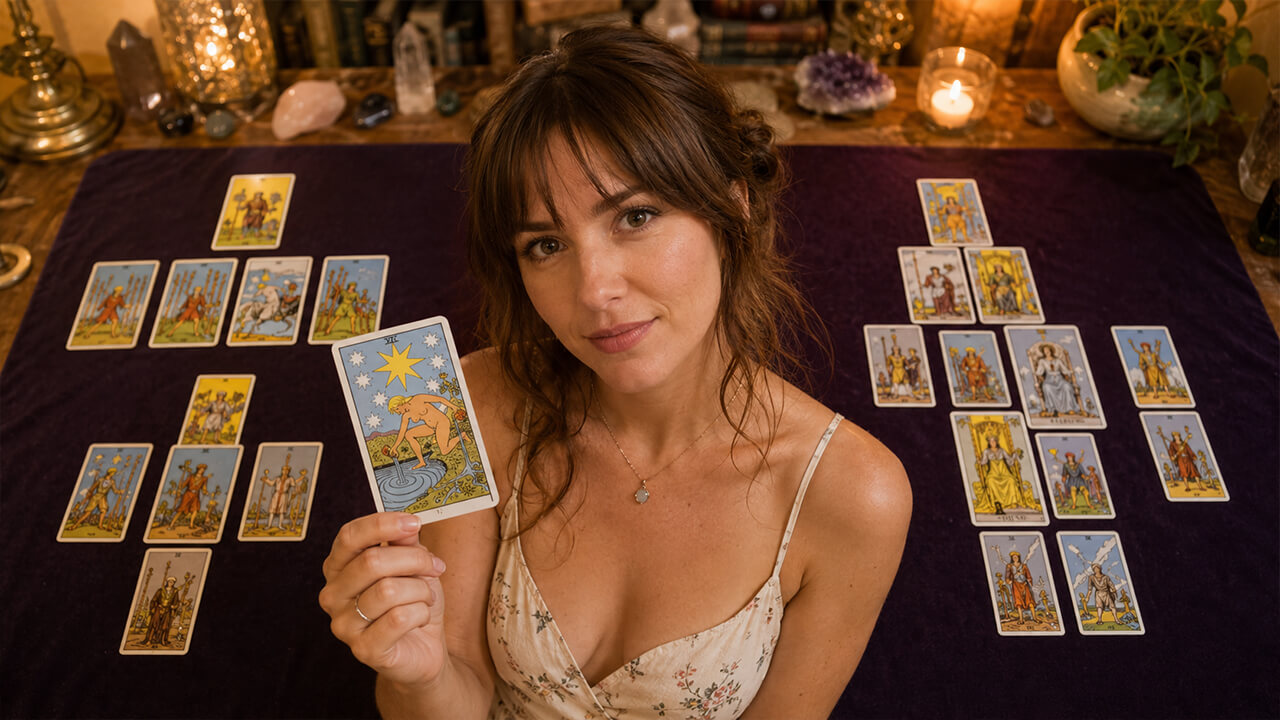
A spread can be arranged in a straight line, a cross, a circle, an arc, or an original shape created for a particular reading. The visual pattern does not make one spread more powerful than another.
What matters is whether the positions form a useful sequence.
A relationship spread might begin with the current state of the connection, then look at each person’s approach, the main pressure between them, and what happens if the existing pattern continues.
A career spread might examine the present role, the reason for dissatisfaction, an ability that is not being used, the practical obstacle, and the next step available.
The positions should answer different parts of the same question.
If several positions ask almost the same thing, the cards can appear repetitive. If every position covers a completely different subject, the reading loses focus.
Clear wording matters.
“What does the future hold?” gives the card a very broad task.
“What direction is this situation taking if communication remains unchanged?” defines both the subject and the condition.
“What should I do?” can produce a useful card, though the instruction is vague.
“What part of my current response needs adjustment?” gives the reader a more specific place to look.
A spread is not a machine that produces certainty.
It is a way of dividing one complicated concern into smaller questions that can be read together.
One-Card and Three-Card Spreads Keep the Question Close
The one-card pull is the smallest tarot spread.
In Japanese tarot practice, it is often called a one-oracle reading. In English, “one-card pull” or “single-card reading” sounds more natural.
The reader asks one focused question and draws one card.
This format works well when the subject is narrow.
What deserves my attention today?
What am I overlooking in this conversation?
Which attitude would help me approach this task more clearly?
One card creates less room for contradiction. It also places more responsibility on the quality of the question.
A broad question such as “What will happen to my life?” gives one card too much work. The World, the Five of Pentacles, or the Page of Wands could each be interpreted in dozens of directions.
A focused question allows the card to remain specific.
A single-card reading can also be used to study tarot. The reader draws one card, observes the image, records the first response, and then compares it with the traditional meaning.
The limitation is obvious.
One card cannot easily separate the present condition from advice, fear, outside influence, and future direction. Readers sometimes solve this by drawing “one more card,” then another, until the original one-card reading has no structure left.
If another question has appeared, it is usually better to name it before drawing again.
The three-card spread gives the reading more movement while remaining easy to follow.
Past, present, and future is the best-known version.
The first card describes the background that shaped the situation.
The second shows what is active now.
The third describes the direction in which the current pattern is moving.
The future card is not a fixed verdict. It reflects the momentum visible at the time of the reading.
If the present card shows avoided communication and the future card shows greater distance, the reading is not claiming that distance must occur. It is showing what the current behavior is producing.
A three-card spread can be adapted in many ways.
Situation, challenge, and response.
What I know, what I do not know, and what needs confirmation.
My position, their position, and the shared dynamic.
Strength, pressure, and practical next step.
These layouts work because the three positions have a clear relationship.
The first establishes the subject.
The second adds tension, information, or contrast.
The third shows how the situation can be approached or where it is heading.
Three cards are often enough for relationship, career, and daily guidance questions. They allow comparison without overwhelming the reader.
Suppose someone asks why a work project has stalled.
The Eight of Pentacles appears in the situation position. The person has been working consistently and developing the necessary skill.
The Two of Swords appears as the challenge. A decision has been postponed, perhaps because both available choices involve a cost.
The Queen of Swords appears as the response. The project needs a clear standard, direct communication, or a decision based on evidence rather than further effort.
Drawing ten more cards would not necessarily improve the answer.
The reading already distinguishes work from indecision and shows the type of response required.
A small spread can be detailed when each position has a clear purpose.
Five-Card, Horseshoe, and Celtic Cross Spreads Add More Context
A five-card spread is useful when three positions feel too compressed but a large layout would create unnecessary detail.
There is no single official five-card arrangement.
The cards may be placed in a straight line, a cross, or a gentle arc. The reader decides what each position represents before drawing.
One practical sequence is the present situation, the underlying cause, what is helping, what is creating pressure, and the likely direction.
Another version looks at the person’s current position, the option being considered, the cost of that option, the alternative, and the next decision that needs to be made.
Five cards can separate emotional and practical concerns.
A person considering a move may feel excited by the new city while worrying about money and support. A three-card spread might combine those concerns too quickly. Five positions can distinguish desire, financial conditions, family response, hidden hesitation, and the immediate action required.
The horseshoe spread usually uses seven cards arranged in an arc.
Its exact positions vary, though common versions include the past, present, near future, the person’s attitude, outside influence, obstacles, and outcome.
Because traditions differ, a reader should state which version is being used. The name of the spread alone does not guarantee that every reader has assigned the same jobs to the seven positions.
The horseshoe works well when a situation has developed over time and outside circumstances matter.
A job change, family disagreement, relocation, or long-running relationship issue may benefit from this wider view.
Seven cards are enough to show movement without reaching the density of the Celtic Cross.
The Celtic Cross is the most widely recognized large tarot spread.
It normally uses ten cards, though the wording of the positions changes among readers and traditions.
The first card represents the central situation.
The second crosses it and usually shows the immediate challenge, pressure, or influence.
The next four cards are placed around the center. They commonly describe the foundation of the matter, the recent past, what is consciously sought or understood, and what is approaching.
A vertical column of four cards is then placed beside the cross.
These positions often represent the reader’s attitude, the surrounding environment, hopes and fears, and the likely outcome.
The Celtic Cross can reveal how several layers of one problem interact.
Someone asking about a relationship may consciously want commitment while privately fearing the loss of independence. The external environment may include family pressure or a demanding work schedule. The outcome card then needs to be read in relation to those conditions, not as an isolated prediction.
The spread is valuable when the question has enough depth to justify ten positions.
It is less useful when the subject is simple.
Asking whether to send a short follow-up email does not usually require the person’s distant past, subconscious foundation, social environment, hopes, fears, and long-term outcome.
A large spread can make an ordinary decision feel heavier than it is.
The Celtic Cross is also difficult for beginners because every card must be read twice.
First, the card needs to be understood in its own position.
Then its relationship with the other nine cards must be considered.
A Cups-heavy spread may show that emotion is shaping the entire reading. Several Pentacles can bring practical conditions forward. Repeated numbers, multiple Court Cards, or several Major Arcana cards add further patterns.
The outcome is not simply the tenth card.
The full spread explains what is producing that direction.
Relationship spreads, decision spreads, career spreads, and monthly spreads are often original variations rather than fixed historical layouts.
One reader may use six cards for relationship compatibility. Another may use eight. Both can work if the positions are clear and do not pretend to reveal facts the cards cannot verify.
A relationship spread can examine the shared dynamic.
It cannot prove another person’s private thoughts.
A decision spread can compare the pressures surrounding two options.
It cannot remove the real consequences of choosing.
The spread organizes reflection. It does not take responsibility for the decision.
The Best Spread Is the One the Question Can Support
More cards do not automatically produce a more accurate reading.
They produce more relationships between cards.
That can add useful detail. It can also create noise.
A reader who already feels anxious may keep finding new warnings in a large spread. One card shows delay. Another shows uncertainty. A third shows an ending. The person combines them into the worst possible story while overlooking the cards that describe preparation, communication, or choice.
The spread should be large enough to separate the important parts of the question.
It should not be so large that the reading creates more problems than the situation contains.
A one-card pull works when one clear point of attention is needed.
Three cards work when the situation needs movement, comparison, or a simple sequence.
Five cards allow emotional, practical, internal, and external factors to be separated.
The horseshoe gives more room to timing and outside influence.
The Celtic Cross suits a layered problem with history, conflicting motives, environmental pressure, and several possible responses.
The reader also needs to know what kind of answer the spread is able to provide.
A future position does not reveal an unavoidable event.
It shows the direction supported by the cards already on the table.
An advice position does not issue an order.
It identifies a quality, action, or perspective that could change how the situation is handled.
A hidden influence does not prove that another person is lying.
It may describe an assumption, fear, motive, or condition that has not been acknowledged.
When a card seems unrelated, the first response should not be to draw a replacement.
The reader can return to the position.
What job was this card given?
Which part of the image speaks to that job?
Does the card describe an action, an emotional condition, a practical limit, or a person’s way of responding?
Sometimes the connection becomes clearer after the rest of the spread is visible.
Clarifying cards can be useful, though they need limits.
One clarifier can show which side of a broad meaning is relevant. Five clarifiers often create a second reading that is less organized than the first.
The same question should not be repeated until a preferred answer appears.
At that point, the person is no longer using a spread to understand the situation. They are asking the deck to relieve uncertainty that only information, conversation, or a decision can address.
A tarot spread works best when the positions remain visible throughout the reading.
The reader knows why each card is there.
The cards can disagree without canceling one another.
Affection can appear beside hesitation.
Opportunity can appear beside a lack of preparation.
An ending can appear beside relief.
The spread gives these different truths separate places on the table.
Its value does not come from how impressive the layout looks.
It comes from helping the reader see which part of the question each card is actually answering.

Sandy Tide Readings
Divination content designer based in Japan. I share astrology content and original divination content inspired by horoscopes, numerology, and planetary placements.
About Sandy Tide Readings ↗