In this article
Personality systems are often approached with a quiet hope. Give me a name for the thing I keep doing.
People check their zodiac sign after a difficult week. They take a personality test after an argument. They save a description because one sentence feels uncomfortably accurate.
For example, someone may keep becoming the person who starts stalled projects at work. Everyone sees confidence and initiative. What they may not see is how difficult it feels for that person to stop, hand over responsibility, or admit that their energy is already gone.
Someone else may notice every change in a room. They know when a coworker is irritated and when a partner is holding something back. They keep the atmosphere comfortable, then arrive home unable to say what they themselves wanted.
The visible behavior can look capable, thoughtful, or dependable. The private cost is harder to name.
A label sometimes brings relief, then quickly becomes another rule. “I’m just the one who leads.” “I always need distance.” “I’m too sensitive for this.” The pattern has been recognized, but the pressure inside it remains untouched.
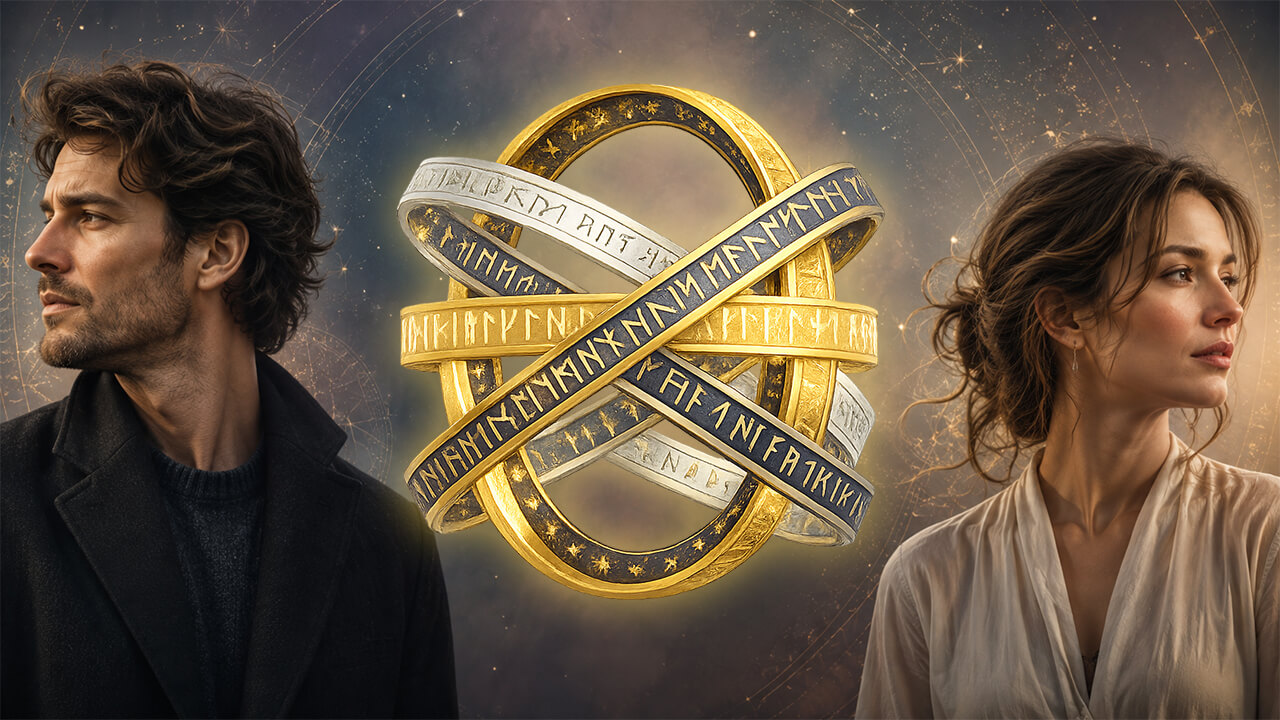
Sixteen-Ring Divination was created for that space. It does not begin with the question of which description sounds most appealing. It looks at how a person’s energy tends to move, how decisions are formed, what becomes visible to others, and what continues beneath the surface.
That difference is the first place to look.
The Question This System Is Trying to Answer
Sixteen-Ring Divination is an original interpretive system that uses a person’s birth date to place them within one of sixteen types.
The word “divination” may create the impression that the system is mainly concerned with predicting what will happen next. Prediction can be part of a reading, especially when current planetary movements are considered, but it is not the starting point.
The starting point is repetition.
Why does one person respond to uncertainty by moving immediately, while another needs to observe first?
Why does one person process an experience by putting it into words, while another decides according to what feels personally right?
Why can two people born under the same zodiac sign experience the same week in very different ways?
A Sun sign alone cannot explain every difference. Neither can a single numerology number. Human behavior rarely comes from one clean source.
Sixteen-Ring Divination places several symbolic structures together so that the relationship between them can be read. Numerology provides the foundation. Elemental qualities describe the style of energy. Mercury and Venus distinguish different ways of processing experience. The Sun and Moon show a difference between more outwardly established patterns and more inwardly reactive ones.
The result is not a ranking of personalities. It is a map of sixteen recurring ways that people initiate action, protect themselves, create relationships, process information, and search for stability.
This matters because strengths and burdens often come from the same place.
The person who acts quickly can open a path when everyone else is hesitating. The same person may move before noticing exhaustion.
The person who reads the atmosphere can prevent unnecessary conflict. The same sensitivity can make it difficult to separate personal feelings from everyone else’s needs.
The system is meant to hold both parts of the pattern at once.
How the Sixteen Types Are Built
The structure can be understood as a four-by-two-by-two arrangement.
There are four Type Elements: Fire, Water, Air, and Earth.
Each elemental type is then viewed through a Mercury or Venus orientation.
That result is divided again through a Sun or Moon orientation.
Four elements multiplied by two planetary orientations and two luminary orientations create sixteen possible structures.
Numerology forms the base of this arrangement. The birth date is used to identify the numerical family that shapes the person’s underlying type. Within Sixteen-Ring Divination, this numerological foundation determines the Type Element used in a standard type reading.
This Type Element is not always the same as the element of the person’s Sun sign.
Someone may have a Water zodiac sign while belonging to a Fire-based Sixteen-Ring type. That is not treated as a mistake or contradiction. The two elements describe different layers.
The Type Element is the structural base of the Sixteen-Ring classification. The zodiac element becomes additional information when a more individual horoscope reading is made.
This distinction helps prevent the system from turning into a renamed version of Sun-sign astrology.
The next division uses Mercury and Venus as symbolic orientations.
Mercury-oriented types tend to process experience through thought, observation, language, judgment, or the organization of information. This does not mean that they are unemotional. It means that their first method of making sense of something is more likely to involve identifying, comparing, explaining, or deciding.
Venus-oriented types place more weight on values, personal resonance, relationships, sensitivity, attraction, and the feeling that something fits or does not fit. They may understand a situation through the quality of the connection before they have a complete verbal explanation for it.
Neither orientation is more intelligent, mature, or emotionally developed than the other. They describe different entry points.
The Sun and Moon create another distinction.
Sun-oriented types tend to express their structure as a clearer baseline. Their qualities are more likely to become recognizable through the role they take, the direction they choose, or the way they affect their surroundings.
Moon-oriented types tend to experience the same structure through reactions, emotional movement, instinctive adjustments, and private habits. The pattern may be strong even when other people do not immediately notice it.
This division contributes to the difference between the Outer Ring and the Inner Ring.
A broader planetary layer is also used within the system. Mars is associated with action and breakthrough. Saturn is connected with limits, structure, continuity, and reality. Jupiter and Uranus relate to expansion, perspective, freedom, and change. Neptune is associated with sensitivity, porous boundaries, imagination, and the unconscious.
These correspondences help describe the driving quality behind each elemental family.
Sixteen-Ring Divination also uses an original indicator called the Celestial Proximity Rate.
The name should not be read as a simple measurement of physical distance in space. It describes how strongly the symbolism of a particular celestial body is likely to resonate with a person or type within this system.
A strong solar resonance can bring themes of purpose, will, visibility, and outward expression to the foreground. A stronger lunar resonance places more emphasis on emotional response, inner fluctuation, safety, and instinct.
Mercury may become more noticeable through decisions, conversations, or mental overload. Venus may appear through relationships, personal values, comfort, attraction, or dissatisfaction.
The Celestial Proximity Rate does not replace a horoscope. It gives the horoscope another layer of differentiation.
Four Groups, Two Rings, Sixteen Symbols
The sixteen types are organized into four larger groups.
Each group contains two Outer Ring types and two Inner Ring types.
* Active Group: Rhinoceros Beetle, Butterfly, Grasshopper, and Ladybug
* Harmony Group: Giant Water Bug, Ant, Cricket, and Mantophasma
* Motion Group: Dragonfly, Bee, Rove Beetle, and Horsefly
* Presence Group: Webspinner, Stag Beetle, Weevil, and Ice Crawler
The Active Group is associated with strong internal energy and the ability to create movement.
These types tend to respond quickly when something needs to begin. They may lead, initiate, express, react, or change the atmosphere before everyone else has decided what to do.
Their difficulty is rarely a lack of momentum. It is recognizing when momentum has become depletion.
The Harmony Group is sensitive to people, emotional tone, and the balance of the surrounding environment.
These types often recognize tension before it is openly discussed. They can support cooperation and make relationships easier to maintain. When that ability is used without enough awareness of their own feelings, accommodation can slowly become self-erasure.
The Motion Group is characterized by active thought, shifting sensitivity, and flexible perspective.
These types notice alternatives. They connect information quickly and often find another route when the obvious one is blocked. Their minds may remain active long after a situation has ended, which can turn flexibility into uncertainty.
The Presence Group is oriented toward support, protection, continuity, and construction.
These types tend to value what can be maintained. They may prefer a dependable process over a dramatic beginning. Their patience gives other people something solid to rely on, though sudden change or unclear expectations can create a heavier burden than they openly show.
The groups describe broad similarities. The rings show where the pattern is most likely to be experienced.
The Outer Ring represents qualities that are more visible in social settings. It includes the roles people naturally take, the impressions they leave, and the ways they influence the flow around them.
The Inner Ring describes reactions and habits that are more strongly experienced inside. An Inner Ring type may appear calm while making constant emotional adjustments. They may seem flexible from the outside while privately working hard to maintain a tolerable amount of distance.
Outer does not mean superficial. Inner does not mean hidden or weak.
They describe the difference between a quality that organizes outward behavior and a quality that shapes inner reception.
The insect names make these structural differences easier to remember.
They are not meant to reduce a person to the literal behavior of an insect. A Rhinoceros Beetle type is not being told to charge into every problem. An Ant type is not expected to serve everyone. A Horsefly type is not defined as restless.
Each insect acts as a symbolic reference point for a particular behavioral strategy.
The Rhinoceros Beetle represents direct initiation. The Webspinner represents sustained construction. The Dragonfly reflects broad perception. The Cricket is linked with sensitivity to subtle signals.
The symbol gives the pattern a recognizable shape. The reading still has to consider how that pattern appears in an actual life.
How It Works With a Horoscope
A basic type describes a recurring structure. A horoscope describes the planetary conditions active during a particular period.
Sixteen-Ring Divination uses both, but it does not confuse them.
New moons, full moons, Mercury retrogrades, planetary conjunctions, eclipses, and the slower movements of planets such as Saturn and Neptune occur collectively. The event is shared. The response pattern is not.
A full moon period may bring emotional and relational matters into clearer view for many people.
For someone with a strong lunar resonance, the experience may center on emotional safety, fatigue, family patterns, or reactions that have been difficult to regulate.
A Venus-oriented type may notice the same period through a relationship, an uncomfortable compromise, a financial preference, or a change in what feels valuable.
A Mercury-oriented type may experience it through a conversation that can no longer be postponed, a decision that needs language, or a mind that has been carrying too much information.
The astrology has not changed. The point of reception has.
This is where the Celestial Proximity Rate becomes useful. It helps identify which planetary theme is more likely to become personally noticeable within a wider astrological event.
The same principle applies to Mercury retrograde.
One person may experience it mainly as scheduling trouble or confused communication. Another may become aware of an old decision-making habit. Someone else may reconsider a relationship because a familiar conversation has returned.
A reading looks at the event, then asks how the type is likely to receive and express it.
This avoids two common problems.
The first is treating every transit as if it produces the same emotional story for everyone. The second is using personality type as if it remains unchanged by timing, environment, age, or circumstance.
The chart provides the period. The type provides a characteristic response. The individual life provides the actual context.
All three are needed for a reading that feels specific without pretending to be absolute.
A Type Is a Starting Point, Not a Verdict
Sixteen-Ring Divination is most useful when it gives language to a pattern without turning that pattern into an excuse.
Being an Active type does not mean every hesitation should be defeated by immediate action.
Being part of the Harmony Group does not require endless patience with relationships that consume more than they return.
An Inner Ring type is not destined to keep everything private. An Outer Ring type does not need to perform strength whenever other people are watching.
The value of the system appears when the description creates a small amount of distance between the person and the habit.
A person may recognize that they do not simply “work hard.” They become the point of origin whenever a group loses direction, then struggle to release control.
Another person may realize that they are not simply “easygoing.” They constantly adjust their presence so that other people remain comfortable.
Those are more precise observations. They can be used.
A Sixteen-Ring reading can help someone understand why certain environments bring out their abilities while others drain them. It can clarify why the same conflict keeps returning in different relationships. It can show why one planetary period feels emotionally heavy for one type and mentally noisy for another.
It does not describe every part of a person.
Family history matters. Culture matters. Health, money, responsibility, opportunity, and lived experience matter. A complete horoscope contains far more information than one type can hold.
The sixteen types offer an organizing structure within that larger reality.
A useful reading leaves a person with something more accurate than “This is just who I am.”
It offers a different sentence.
“This is the pattern I tend to reach for first. Now I can see where it helps, where it costs me, and where I still have room to choose.”
Sandy Tide Readings
Divination content designer based in Japan. I share astrology content and original divination content inspired by horoscopes, numerology, and planetary placements.
About Sandy Tide Readings ↗