In this article
- 🌐 What the governments are actually preparing people for
- ♇ October's astrology: Pluto in Aquarius and Uranus in Gemini
- ☿ Mercury retrograde and the vulnerabilities we rarely see
- 🌕 The October 26 Taurus Full Moon and Pluto's T-square
- 🌪️ Natural disasters and human-made emergencies: two different threats, similar consequences
- ☀️ The Sun, Moon, and the relationship between governments and ordinary people
- 🔢 November 2 and the numerology of a new beginning
- 🌑 November 9: The Scorpio New Moon and hidden vulnerabilities
- 🔄 November 13–14: Mercury and Venus turn direct
- 🔥 November 16: Mars conjunct Jupiter in Leo
- 📡 November 24: The Gemini Full Moon and the risk of communication failures
- ⚡ November 29: Uranus trine Pluto and the changes carrying into 2027
- 🌍 Japan's announcement adds another dimension
- 🕯️ Why I think the coming week deserves extra attention
On October 22, 2026, the British government launched a new public awareness campaign called "Be Ready," encouraging households to prepare for emergencies that could interrupt essential services.
The advice includes keeping some non-perishable food and bottled water at home, having a flashlight and a way to charge your phone, and thinking about what to do if electricity, water, or communications suddenly become unavailable. The government also recommends signing up for the Priority Services Register if you need additional support from utility providers.
The campaign is part of a three-year effort to improve household preparedness, with particular attention to severe weather and the disruptions that can follow. The guidance builds on advice the government has been publishing since 2024.
There's nothing unreasonable about any of that. Storms, flooding, and power outages are familiar problems, and having basic supplies available is sensible.
Still, the timing bothered me.
Just four days later, on October 26, Japan's disaster preparedness minister announced plans to make a nationwide appeal for households to maintain emergency supplies, including food, drinking water, and sanitation essentials.
Two countries facing different kinds of natural hazards, making similar announcements within days of each other. I found that coincidence hard to ignore.
So I started looking at what other governments had been saying.
On October 9, Luxembourg's government introduced a national guide to surviving the first 72 hours of an emergency without outside assistance. Prime Minister Luc Frieden and other senior officials presented the guidance, with approximately 300,000 copies scheduled for distribution to households across the country.
Three days later, on October 12, the Dutch government launched another phase of its "Denk vooruit" campaign, encouraging people to prepare for 72 hours without electricity, running water, or internet access.
Then Norway began its annual Self-Preparedness Week on October 26. Norway has recommended a week's worth of household supplies for some time, but this year's campaign focuses on a particularly modern problem: what happens when mobile networks and the internet stop functioning?
Put those dates together, and the pattern becomes difficult to overlook. Luxembourg on October 9, the Netherlands on October 12, Britain on October 22, and Norway on October 26. Japan made its announcement that same day.
These initiatives have different histories. Norway's preparedness week is an annual event, and the UK's guidance was already in place before the latest campaign. Luxembourg's publication also follows a national resilience strategy introduced in 2025.
But seeing so many governments address the same basic concern within a few weeks still makes me uneasy.
What caught my attention wasn't simply how many days of food or water people were being asked to store. It was the kind of emergency these governments wanted ordinary households to imagine.
And when I looked at the astrology of late October and November, there were several configurations I couldn't quite put out of my mind.
🌐 What the governments are actually preparing people for
The announcements have something important in common. Alongside floods, storms, and other natural disasters, they place considerable emphasis on the possibility of losing electricity, water, communications, and internet access.
Luxembourg's guidance explicitly includes cyberattacks and disruptions to essential public services. The Dutch campaign addresses failures affecting electricity, water, and the internet, while Norway is concentrating on how people can receive information and communicate when mobile networks stop working.
It becomes a rather different conversation once you start thinking about emergencies in those terms.
Modern life depends on an extraordinary number of interconnected systems. Electricity powers far more than lights and refrigerators. A prolonged outage can affect payment terminals, telecommunications, water supply infrastructure, transportation, and the businesses that deliver everyday essentials.
If the internet becomes unavailable, banking, work, government services, and even basic communication can become difficult. If deliveries stop, having money in your account doesn't necessarily mean you can buy what you need.
And these problems don't always remain within national borders.
Financial networks, energy systems, cloud services, and supply chains connect countries in ways that most of us rarely have reason to think about. A failure in one place can create consequences somewhere entirely different.
We've made life incredibly convenient, but maintaining that convenience now requires a level of coordination and technical complexity that would have been difficult to imagine a few decades ago.
That leaves me wondering how much control ordinary people really have when one of those systems suddenly becomes unavailable.
Cyberattacks, data breaches, software vulnerabilities, and interruptions to public or commercial services have become recurring concerns. The more I follow these developments, the more closely technology and national security seem to be connected.
A powerful storm can take down a communications network. So can a deliberate attack on infrastructure, even when the weather is perfectly normal.
From the perspective of the household affected, the immediate consequences may be remarkably similar.
You can't get water. You can't pay for groceries. You can't contact your family, and you may not know where to find reliable information.
These situations don't necessarily come with much warning. A service that worked yesterday may be unavailable tomorrow, which is exactly why I find the recent government announcements more unsettling than a routine reminder to keep emergency supplies at home.
♇ October's astrology: Pluto in Aquarius and Uranus in Gemini
Looking at the wider astrological picture, 2026 has been an especially interesting year.
Several slow-moving planets have entered new signs. Neptune and Saturn are in Aries, Uranus has moved into Gemini, and Pluto continues its journey through Aquarius.
I've been interested in these changes for some time, particularly what they might suggest about institutions, technology, information, and the way society is organized.
The combination of Pluto in Aquarius and Uranus in Gemini stands out.
Pluto is associated with profound transformations in power, control, and structures that have developed over long periods. Aquarius brings collective systems, networks, technology, and the relationship between individuals and society into the picture.
Uranus is closely linked with innovation, electricity, sudden changes, and challenges to established arrangements. Gemini connects with communication, transportation, information, and exchange.
With both planets in air signs, questions about information networks and the infrastructure supporting modern life feel especially relevant.
We've gained enormous freedom through digital technology, yet so many ordinary activities now depend on relatively concentrated networks, institutions, and service providers. When something fails, the consequences can spread faster than people can fully understand what happened.
Uranus and Pluto formed a trine in July 2026 and will form another exact trine on November 29.
Trines are usually described as harmonious aspects. But when we're dealing with planets as powerful and slow-moving as Uranus and Pluto, a smoother connection between their principles can also accompany changes that transform society on a substantial scale.
Technological innovation can advance faster than governments and institutions can develop the safeguards surrounding it. New systems can take over functions that older institutions once controlled, raising difficult questions about responsibility, security, and public trust.
That seems particularly relevant now.
Pluto stationed direct in Aquarius on October 16, bringing another point of interest to a month already filled with discussions about national resilience.
I find myself wondering whether we're entering a period in which the question is no longer simply how much technology can improve our lives, but how much of that technology society can afford to depend on.
There's a difference between having a sophisticated system and having one that can continue functioning when something goes wrong.
And with these two planets continuing their relationship into 2027, I suspect the distinction will become increasingly important.
☿ Mercury retrograde and the vulnerabilities we rarely see
Mercury stationed retrograde in Scorpio on October 24.
Mercury is traditionally connected with communications, information, transportation, commerce, contracts, and the exchange of messages. Scorpio draws attention to shared resources, financial connections, hidden vulnerabilities, and relationships built on mutual dependence.
Together, those themes make me think about the systems operating behind the scenes of everyday life.
When you transfer money, make a payment, send a message, or order something online, you rarely need to understand the complicated processes taking place in the background. You expect the transaction to go through because that's what usually happens.
It's only when something fails that the hidden connections suddenly become visible.
Mercury retrograde occurs several times a year, but this particular period comes alongside Pluto's recent station and Venus retrograde. That gives the symbolism a different texture, especially with Mercury moving through Scorpio.
Scorpio has much to do with resources we share or depend on collectively, rather than things we possess entirely on our own.
What happens when an institution responsible for something essential can no longer provide it? How much do we know about the services we rely on, and how would we manage without them?
Those questions have been following me since I started comparing the preparedness campaigns.
With Mercury retrograde beginning on October 24 and Japan's emergency preparedness announcement arriving on October 26, the opening days of this period seem worth paying particular attention to.
I don't want to spend the coming week merely watching reports about possible disruptions. I'd rather know that important contact details, alternative payment options, and a way to receive information during a power outage are already accounted for.
Especially now, postponing those small preparations seems unnecessary.
🌕 The October 26 Taurus Full Moon and Pluto's T-square
One of the most striking astrological events of the month occurred on October 26, when the Moon reached fullness in Taurus at approximately 04:11 UTC.
The Moon was near 2°45' Taurus, directly opposite the Sun in Scorpio. Pluto, positioned near 3° Aquarius, formed a square to both luminaries.
This created a tight T-square.
Taurus is associated with food, land, possessions, housing, physical comfort, and the resources that allow us to maintain a stable life. These are tangible things, the ones we often take for granted until they're threatened.
Scorpio, on the opposite side of the zodiac, brings shared resources, financial obligations, dependency, and the less visible connections that bind individuals and institutions together.
Pluto in Aquarius adds questions about collective power, infrastructure, and the transformation of the systems society relies upon.
What interested me about this configuration was how closely those symbols resembled the concerns appearing in the government announcements.
A household might have enough money and supplies to feel secure, but a prolonged breakdown in public infrastructure can make ordinary life difficult. Meanwhile, even a well-prepared government cannot deliver assistance to every household immediately after a major emergency.
Personal security and the stability of collective systems are deeply connected.
The Taurus Moon suggests our need to protect what sustains us. The Scorpio Sun illuminates the resources and obligations we share. Pluto introduces pressure from the larger structures that make daily life possible.
Seeing those three principles in such a tense configuration during the same week that governments were discussing emergency supplies was hard to dismiss as an interesting piece of symbolism.
Venus, the ruler of Taurus, was also retrograde at the time.
Venus is associated with relationships and personal values, but money, possessions, and material comfort belong to its symbolism too. Retrograde Venus can invite us to reconsider what we value and what we assume will remain available.
We usually associate financial security with how much money we have. Yet having money becomes a rather different matter if digital payments stop working, or if deliveries are interrupted and the shelves are empty.
It brings up a question I keep returning to: how much of what we call security depends on our own resources, and how much depends on the world around us continuing to function?
The Taurus Full Moon gives that question a particularly concrete quality.
As its influence carries into the final days of October and the beginning of November, I think food, water, electricity, and communication deserve more immediate attention than we might ordinarily give them.
🌪️ Natural disasters and human-made emergencies: two different threats, similar consequences
Looking across the government announcements, two broad categories of emergency stand out.
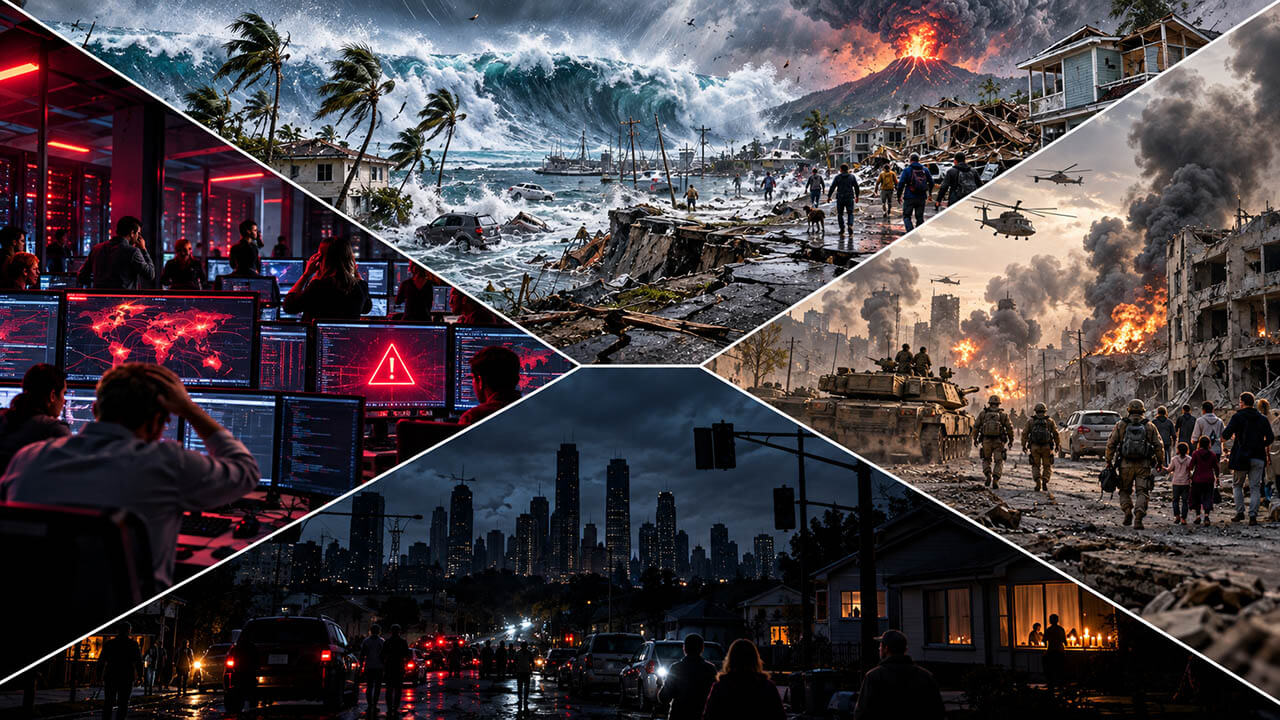
The first includes natural disasters: earthquakes, tsunamis, floods, hurricanes, volcanic eruptions, and other events driven by the physical environment.
The second involves human activity and the systems we've built: cyberattacks, sabotage, warfare, power-grid failures, and major technological disruptions.
In today's world, the consequences can overlap in ways that make the distinction less useful once an emergency begins.
An earthquake can damage roads, electricity infrastructure, water systems, and communications facilities at the same time. A sophisticated cyberattack might interrupt some of those very same services without any physical disaster taking place.
Astrologers have historically examined combinations involving Uranus, Pluto, Mars, Saturn, and earth signs when considering upheaval, conflict, and natural hazards.
The October Taurus Full Moon, with its powerful square to Pluto, makes the security of land, possessions, and essential resources particularly interesting.
But what concerns me even more is how disruption in one area might spread through the systems around it.
Pluto in Aquarius and Uranus in Gemini suggest a broader conversation about communication, technological change, collective organization, and the vulnerabilities created by dependence on interconnected infrastructure.
A flood and a cyberattack can have completely different causes, yet both may leave communities without electricity, working payment systems, or reliable communications.
It's easy to discuss these possibilities as abstract national security concerns. It's much harder to imagine them happening in the middle of an ordinary working day, when you're trying to get home, reach your family, or buy dinner.
That is why the practical consequences matter to me.
Emergencies don't always arrive with enough warning to give everyone time to prepare, and the first hours can be especially confusing. Whether the cause is natural or human-made, there's value in knowing how you'll manage if the services you normally depend on suddenly stop.
☀️ The Sun, Moon, and the relationship between governments and ordinary people
Mundane astrology offers another layer to this discussion.
When examining national and collective affairs, the Sun is traditionally associated with leadership and the government, while the Moon reflects the public, collective needs, and the conditions of everyday life.
At the October 26 Full Moon, the Sun in Scorpio faced the Moon in Taurus, with Pluto in Aquarius forming squares to both.
I see an interesting parallel between that configuration and the relationship between governments trying to manage national emergencies and households simply wanting to feel secure.
The language of these preparedness campaigns is revealing.
Governments are still responsible for infrastructure, emergency services, and coordinating assistance, but they're also asking individuals and communities to take greater responsibility for the first stages of a crisis.
That raises uncomfortable questions about what people can reasonably manage for themselves.
An elderly person living alone may face very different challenges from a family with a car and storage space. Someone with limited income may have difficulty keeping additional food, water, and essential supplies at home.
A prolonged outage can also affect people whose medical equipment, mobility, or daily care depends on electricity and outside services.
Those circumstances matter, and I was interested to see that the British government's campaign was developed with organizations supporting people facing housing insecurity and food poverty. Some of the recommended preparations cost nothing, including registering for additional utility support where appropriate.
In mundane astrology, the fourth house is associated with the homeland, land, and the foundations of collective life. The sixth brings public services, working conditions, and health into consideration. The seventh is relevant to foreign relationships and conflict, while the eighth involves shared resources, debt, and collective financial burdens.
The twelfth can also become relevant when examining hidden pressures or difficulties within institutions.
The precise house placements vary according to the location and chart being examined, which is important when looking at different countries.
Britain may be particularly concerned about severe storms, flooding, and the continuity of essential services. Elsewhere in Europe, cybersecurity, communications infrastructure, and geopolitical security may receive greater emphasis.
Different countries can experience the same broad social concerns in very different ways.
What they increasingly seem to share is the recognition that emergency assistance cannot reach everyone at once. In the first hours or days, the relationship between the individual, the community, and the state becomes very real.
And that brings us directly to November.
🔢 November 2 and the numerology of a new beginning
November 2 is an interesting date to examine through numerology, especially given the timing of the announcements and the institutional changes taking place.
The digits of 2026 add up to 10, which reduces to 1.
In numerology, a Universal Year 1 is associated with beginnings, independence, initiative, and the opening of a new nine-year cycle. It can describe a period when familiar arrangements give way to new approaches and people are required to make decisions under changing circumstances.
November introduces the number 11, often treated as a master number and associated with heightened awareness, sensitivity, ideals, and intuition.
Reduce 11 to 2, and the emphasis shifts toward cooperation, relationships, shared responsibility, and the need to work with others.
That seems like an intriguing combination for a month in which governments are discussing both individual preparedness and cooperation between public agencies, businesses, communities, and households.
Then there's November 2 itself.
Add the digits of the full date, 2026-11-02, and the result is 14, which reduces to 5.
Five is associated with change, adaptation, flexibility, mobility, and a willingness to move beyond familiar structures.
The symbolism brings together three different ideas: the beginning represented by 1, the cooperation represented by 11/2, and the flexibility represented by 5.
There's a tension within that combination that I find interesting.
Institutions can announce new policies and establish new procedures, but their effectiveness depends on the people and organizations involved actually being able to work together. Adaptability matters just as much as the existence of a plan.
This becomes especially relevant when considering national emergency response.
A government can invest in preparedness, yet emergencies rarely unfold exactly as planned. Infrastructure, local authorities, volunteers, businesses, and ordinary households all become part of the response.
Looking at November 2 through numerology, I find myself thinking less about what any single government might announce and more about how societies are beginning to redefine responsibility.
The astrology around the date adds another layer.
The Sun and retrograde Mercury are in Scorpio, while Venus remains retrograde in Libra. The Moon is in Leo, where Mars and Jupiter are also positioned.
Leo carries associations with leadership, authority, visibility, and the desire to assert a clear direction. Mars brings initiative, decisive action, and the capacity to respond under pressure, while Jupiter expands whatever questions of leadership, ambition, and public policy are already receiving attention.
At the same time, Mercury retrograde in Scorpio brings us back to communication procedures, shared resources, institutional dependencies, and the less visible details of how an organization actually functions.
It's one thing to announce a new approach to emergency preparedness. It's another to make sure information reaches the right people, responsibilities are understood, and essential services continue functioning under pressure.
That difference feels especially important during the first week of November.
🌑 November 9: The Scorpio New Moon and hidden vulnerabilities
On November 9, at approximately 07:02 UTC, a New Moon takes place at 16°53' Scorpio.
This brings Scorpio back into focus less than two weeks after the Taurus Full Moon.
The October lunation highlighted the relationship between personal security and collective resources. Now the Sun and Moon meet in the sign associated with shared finances, obligations, insurance, hidden vulnerabilities, and complicated relationships of mutual dependence.
I find that sequence particularly interesting.
The question shifts from what a household needs to survive to the larger arrangements that determine what happens when a crisis affects everyone.
Who pays for the damage? Which institution is responsible for maintaining a critical service? How is information shared between government departments and private companies? And how quickly can the different parties respond when something goes wrong?
Modern infrastructure makes these questions surprisingly complicated.
Water, energy, communications, banking, and transport all depend on overlapping systems of public oversight and private operation. In some cases, vulnerabilities remain largely invisible until a serious disruption exposes them.
Scorpio is an interesting sign through which to consider those hidden dependencies.
Mercury and Venus are still retrograde at the New Moon, keeping attention on information, financial arrangements, relationships, and questions of value.
I wouldn't be surprised if discussions about the cost of preparedness, responsibility for essential services, or weaknesses within established systems became increasingly prominent around this period.
The New Moon also makes me wonder whether the public conversation will move beyond emergency supplies toward the institutions responsible for keeping societies functioning.
Who carries the burden when those institutions fail?
It's a question with no particularly comfortable answer, especially in a world where so much of our daily security is shared.
🔄 November 13–14: Mercury and Venus turn direct
Mercury stations direct in Scorpio on November 13 at approximately 15:54 UTC. Venus follows in Libra on November 14 at approximately 00:28 UTC.
Two planets changing direction within less than nine hours make this a noteworthy moment in the month's astrological calendar.
Mercury's return to direct motion suggests a transition from reviewing communications, procedures, and information toward putting decisions into practice.
Venus turning direct in Libra draws attention to cooperation, agreements, fairness, and the relationships required to make collective arrangements work.
I find the sequence especially relevant after the themes raised earlier in November.
New preparedness initiatives may begin with governments making announcements, but their effectiveness depends on coordination. Local authorities need reliable channels of communication. Organizations need agreements about their responsibilities, and communities need some understanding of who may require additional help.
Those relationships don't necessarily attract much attention when everything is functioning normally.
They become much more important when something breaks down.
And just as Mercury and Venus return to direct motion, another planetary configuration begins to stand out.
🔥 November 16: Mars conjunct Jupiter in Leo
On November 16, at approximately 06:23 UTC, Mars and Jupiter form a conjunction at 25°53' Leo.
This is one of the November aspects I find particularly compelling.
Mars is connected with initiative, confrontation, competition, military affairs, and the willingness to act decisively. Jupiter expands the themes it touches and can bring questions of law, leadership, ambition, and collective ideals into sharper focus.
Their conjunction in Leo adds the symbolism of authority, national prestige, leadership, and the desire to make a strong public statement.
From the perspective of world affairs, the combination draws my attention toward governments asserting their priorities, expanding security measures, or taking more forceful positions on matters they consider important.
There is a constructive side to Mars and Jupiter working together. The same combination can accompany ambitious projects, institutional reforms, or a willingness to tackle problems that have been neglected for too long.
But Mars can also introduce competition and confrontation, while Jupiter has a tendency to magnify what is already happening.
That becomes worth watching in a period when governments are discussing national security, emergency response, and the protection of infrastructure.
Saturn and Neptune are also in Aries, a sign traditionally ruled by Mars and associated with initiative, independence, and decisive action.
Against that background, the Mars–Jupiter conjunction feels particularly forceful.
What happens when national security becomes an increasingly prominent political concern? How do governments balance the need to prepare with the risk of escalating existing tensions?
The different priorities appearing in October's preparedness campaigns make these questions especially relevant.
Some countries are primarily addressing natural hazards and severe weather. Others are explicitly considering cyberattacks, sabotage, and warfare.
The underlying desire to improve resilience may be similar, but the political consequences can be quite different.
I'll be watching how governments discuss security and emergency response around the middle of November, particularly whether those discussions begin to influence economic decisions, public spending, or international relationships.
📡 November 24: The Gemini Full Moon and the risk of communication failures
The next Full Moon arrives on November 24 at approximately 14:53 UTC, at 2°20' Gemini.
This is another configuration that immediately caught my attention.
Gemini is associated with information, communication, transportation, commerce, and the movement of people and ideas.
And Uranus is also in Gemini.
At the Full Moon, the Moon is close to Uranus, creating a conjunction between the public-facing symbolism of the Moon and the unpredictable, technological qualities of Uranus.
The Sun stands opposite in Sagittarius, a sign associated with international connections, laws, institutions, and the exchange of ideas across borders.
On November 25, at approximately 22:41 UTC, the Sun forms an exact opposition to Uranus.
For a period already marked by discussions about communications infrastructure, this is a particularly striking sequence.
Norway's October preparedness campaign focused on the loss of mobile networks and internet access. Other governments have also been encouraging households to consider how they would receive information or stay in contact during a serious disruption.
Now the November Full Moon brings Gemini and Uranus together, placing the symbolism of communications and sudden technological changes close to the center of the chart.
What interests me here is the relationship between information and public confidence.
If communication networks fail during an emergency, the immediate problem isn't simply that people can't send messages. They may also struggle to find reliable instructions, learn whether loved ones are safe, or understand what's happening around them.
In a highly connected society, uncertainty can spread almost as quickly as information.
And because digital systems cross borders, the consequences of a major interruption can extend far beyond the location where the original problem occurred.
This is a period when I want to pay especially close attention to developments involving communications, infrastructure security, and the reliability of the systems people depend on.
It also makes me think about something practical: knowing where to obtain trustworthy information when the usual digital channels aren't available.
That might seem like a small concern until the moment it becomes essential.
⚡ November 29: Uranus trine Pluto and the changes carrying into 2027
On November 29, at approximately 11:22 UTC, Uranus in Gemini forms another exact trine to Pluto in Aquarius.
The two planets formed the same aspect in July, and their relationship will continue into 2027.
Of all the configurations discussed here, this is the one I find most important for understanding the longer-term picture.
Uranus is connected with technological innovation, electricity, communications, reform, and disruptions to established systems. Pluto brings questions of concentrated power, structural transformation, and the forces that reshape institutions from within.
Both are now in air signs, giving additional symbolic emphasis to networks, information, and collective organization.
Their trine is often considered harmonious, but the relationship between two transformative planets can still coincide with profound changes in the systems society relies on.
Innovation can solve old problems while creating entirely new dependencies. Institutions may need to reconsider their roles, and security standards developed for an earlier technological environment may struggle to keep pace.
Financial systems, government services, communications, and the infrastructure supporting everyday life are already undergoing enormous changes.
That's why the wave of preparedness announcements interests me beyond the immediate question of food and bottled water.
Governments are asking households to take greater responsibility for periods when familiar services may not be available. At the same time, society continues to place more of its essential functions in increasingly sophisticated and interconnected systems.
There is something contradictory about that.
The technology becomes more powerful, more convenient, and more deeply embedded in our lives, while ordinary people are being encouraged to prepare for the possibility that it might suddenly stop working.
I think that contradiction will become an increasingly important part of the conversation as we move toward 2027.
Perhaps the challenge isn't simply to build more advanced systems, but to make sure societies can still function when those systems are interrupted.
And when I consider the Uranus–Pluto trine through that lens, the events of October feel like part of a much larger change in how governments and communities think about security.
🌍 Japan's announcement adds another dimension
There's one final country worth returning to, because its announcement came so close to the UK's.
On October 26, Japan's disaster preparedness minister announced plans for a nationwide appeal encouraging households to maintain at least three days, preferably a week, of food, drinking water, and emergency sanitation supplies.
The appeal was planned to coincide with the November 2 launch of the country's new National Disaster Management Agency.
Japan faces particularly serious risks from major earthquakes, tsunamis, volcanic eruptions, and typhoons. In a large-scale disaster, damage to transport routes, electricity networks, and water systems can make it difficult for supplies to reach affected communities quickly.
That creates a different emphasis from the European campaigns, many of which are also drawing attention to digital communications and cybersecurity.
Yet the underlying concern is familiar: what happens when the systems supporting ordinary life become unavailable, and how long can households manage before assistance arrives?
I was also struck by the November 2 launch date in light of the numerological combination discussed earlier.
The Universal Year 1, the master number 11, and the full date's reduction to 5 bring together themes of beginnings, cooperation, and adaptation.
Establishing a new national agency reflects an institutional attempt to strengthen emergency response. But the much harder question is how those changes translate into practical protection for people when a serious crisis occurs.
Japan's experience makes the natural-disaster side of this discussion particularly concrete.
A major earthquake could affect housing, electricity, water, transportation, and communications simultaneously. The same kinds of disruption that European governments are preparing for through different scenarios can emerge from a single natural event.
That overlap is what stays with me.
🕯️ Why I think the coming week deserves extra attention
When I put the government announcements alongside the astrology of late October and November, this period feels unusually significant.
The October 26 Taurus Full Moon formed a tight T-square with Pluto, drawing attention to material security and the collective systems supporting it. Mercury and Venus are retrograde, and November brings a Scorpio New Moon, the return of both planets to direct motion, a Mars–Jupiter conjunction in Leo, a Gemini Full Moon close to Uranus, and another Uranus–Pluto trine.
Each configuration raises a somewhat different question, but they seem to circle around the same concerns: security, infrastructure, shared responsibility, information, and the capacity of societies to respond when normal conditions change.
I'm especially conscious of the period from October 29 through approximately November 4.
The Taurus Full Moon is still recent, Mercury and Venus remain retrograde, and the opening days of November bring renewed attention to government preparedness and emergency response.
I see this as a week to take our everyday dependencies more seriously.
We don't know what tomorrow will bring, and that's precisely what makes preparedness matter. An emergency may be caused by severe weather, a technical failure, an accident, or deliberate interference with essential infrastructure. Whatever the cause, ordinary households can be affected before anyone has a clear picture of what's happening.
The fact that several governments have been addressing these concerns within such a short period continues to bother me. I don't want to dismiss the timing simply because the campaigns have different administrative histories.
At the same time, the most useful response isn't to sit around imagining every possible catastrophe.
The UK's Be Ready campaign offers a much more practical starting point: keep some drinking water and food that doesn't require refrigeration, have a flashlight and spare batteries, make sure you have a way to charge your phone, and keep essential medication accessible.
A battery-powered or wind-up radio can provide another route to important updates if normal communications are disrupted. The government also encourages people to check on neighbors and consider who might need assistance, while eligible households can sign up for the Priority Services Register.
These are ordinary steps, but their value becomes much greater when something unexpected happens.
The old saying "Fix the roof while the sun is shining" feels particularly appropriate.
There's a temptation to assume that tomorrow will function much like today, because that's what we're accustomed to. Yet so much of modern life depends on things we cannot personally control.
For now, the lights are on, the water is running, and our phones connect us to the world.
That makes this a good time to look around and ask what we would do if, even briefly, they didn't.
Sandy Tide Readings
Divination content designer based in Japan. I share astrology content and original divination content inspired by horoscopes, numerology, and planetary placements.
About Sandy Tide Readings ↗