In this article
When people first open a birth chart, the planets and zodiac signs usually make sense before the lines do.
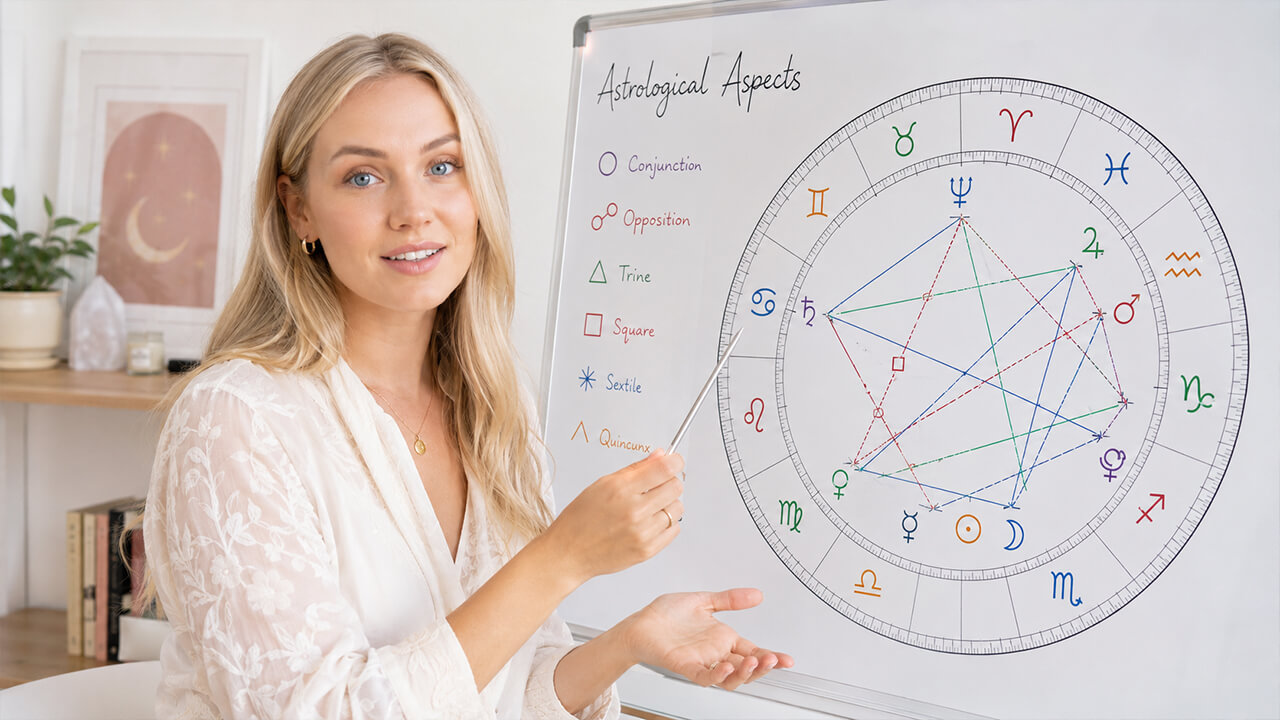
The chart may contain red lines, blue lines, dotted lines, and symbols crossing the center. Red is often assumed to mean trouble. Blue looks reassuring. A chart with many red lines can feel difficult before anyone has explained what those lines are measuring.
For example, someone notices Venus square Saturn in their birth chart.
They search for the aspect and find descriptions involving rejection, loneliness, and delayed love. A few minutes later, they see Sun trine Jupiter and read that it brings confidence, generosity, and good fortune.
The chart starts to look like a scorecard.
One placement seems to take something away. Another appears to compensate for it. The person begins adding strengths and subtracting difficulties, hoping the final result will explain whether the chart is good.
That habit creates more pressure than understanding.
A square does not automatically describe failure. A trine does not guarantee that its potential will be used well. Even a conjunction cannot be interpreted before we know which planets are involved.
Aspects describe relationships between planetary functions. They show where different parts of the chart cooperate, compete, reinforce one another, or demand adjustment.
Before deciding which lines are helpful and which are difficult, the first place to begin is what an aspect actually measures.
An Aspect Is an Angular Relationship Between Two Points
A birth chart places the planets around a circle of 360 degrees.
Each planet occupies a particular degree of a zodiac sign. The angular distance between two planets creates an aspect.
When two planets occupy nearly the same degree, they form a conjunction.
When they are approximately 60 degrees apart, they form a sextile.
At 90 degrees, they form a square.
At 120 degrees, they form a trine.
At 180 degrees, they form an opposition.
These are the five major aspects used most often in Western astrology.
The numbers matter because each angle describes a different kind of relationship. A square does not feel different from a trine because one has been declared bad and the other good. Their geometry places the planetary functions in different forms of contact.
A conjunction combines.
A sextile creates an opportunity for cooperation.
A square produces pressure and demands action.
A trine allows energy to move easily.
An opposition creates awareness through contrast.
The exact angle is important, but planets do not need to be positioned at a mathematically perfect distance to form an aspect.
Astrologers use an orb, which is the amount of distance allowed on either side of the exact angle.
Suppose the Sun is at 10 degrees Aries and the Moon is at 12 degrees Cancer.
Aries and Cancer form a 90-degree relationship by sign. The planets are two degrees away from an exact square, so the aspect has an orb of two degrees.
A closer aspect is generally experienced as more concentrated. A conjunction with an orb of one degree usually receives more attention than a conjunction with an orb of eight degrees.
The planets involved affect how much orb an astrologer allows.
The Sun and Moon are often given wider orbs because they are central to identity, vitality, instinct, and emotional regulation. Minor points and asteroids are usually read with tighter orbs.
There is no single orb rule followed by every astrologer.
Some use eight to ten degrees for conjunctions involving the Sun or Moon. Others prefer a tighter range. Some reduce the orb for sextiles and increase it for oppositions.
The useful question is not whether one system is universally correct.
It is whether the aspect is close enough to create a recognizable relationship between the two functions.
An aspect can also be applying or separating.
An applying aspect occurs when the faster-moving planet is approaching the exact angle. A separating aspect occurs after the exact contact has already taken place.
Some astrologers give applying aspects greater emphasis because the two planets are moving toward contact. Separating aspects are sometimes read as patterns that feel more established or familiar.
This distinction can add detail, but it should not replace the basic interpretation.
The planets still matter most.
Mars square Saturn is not difficult because 90 degrees is an unlucky number. It is difficult because the impulse to act meets restraint, timing, fear, responsibility, or external limits.
Venus trine Jupiter is not pleasant because 120 degrees is automatically fortunate. It is pleasant because affection, value, pleasure, generosity, confidence, and expansion can support one another with relatively little resistance.
The aspect describes the relationship.
The planets describe what is relating.
The signs describe how those functions behave.
The houses show where the relationship becomes especially noticeable in life.
A complete reading needs all four layers.
Conjunctions Bring Two Planetary Functions Into the Same Space
A conjunction occurs when two planets are close together in the zodiac.
Its exact angle is zero degrees.
Conjunctions are often described as powerful because the two planetary functions are difficult to separate. They operate from the same area of the chart and frequently respond to the same event at the same time.
A conjunction is not automatically harmonious.
It is a concentration.
The quality depends on the planets involved, the sign, the house, and the aspects the conjunction receives from the rest of the chart.
Consider the Sun conjunct Mercury.
The Sun describes identity, vitality, purpose, and the need to act with personal authorship. Mercury describes thought, language, interpretation, and the exchange of information.
When they are conjunct, identity and thought become closely linked.
The person may speak with conviction because ideas feel personal. They may understand themselves through writing, conversation, study, or explanation. Their voice can become an important part of how they establish a place in the world.
The same closeness can make disagreement difficult.
A challenge to an opinion may feel like a challenge to the person. They may continue explaining because being misunderstood feels more serious than a simple difference of interpretation.
The conjunction does not say that the person is intelligent or unintelligent.
It says that thought and identity work in close contact.
Now consider the Moon conjunct Saturn.
The Moon is connected with emotional habits, safety, memory, instinct, and bodily comfort. Saturn concerns structure, limits, responsibility, restraint, time, and consequence.
This conjunction may produce emotional reliability.
The person can remain composed during difficult situations. They may take family responsibilities seriously, remember what others depend on, and provide practical support when emotional language is not enough.
The concentration can also create self-restraint.
The person may believe that feelings should be handled privately. They can postpone asking for comfort until every practical task is complete. Other people may assume they need very little because their needs are rarely made visible.
Moon conjunct Saturn is sometimes described as emotional coldness.
That misses the internal burden.
The person may feel deeply while treating emotional control as a condition of safety.
A Venus-Mars conjunction has a different tone.
Venus describes attraction, affection, values, pleasure, and the way someone forms connection. Mars describes desire, action, anger, pursuit, and assertion.
Together, they can create strong creative and relational energy.
The person may know quickly what attracts them. Affection and desire can reinforce one another. They may express interest directly or feel most alive when creating, pursuing, or responding to something they value.
The same conjunction can make relationships highly charged.
Disappointment may turn into irritation quickly. Attraction can be mistaken for compatibility. The person may pursue what they want before deciding whether it supports the kind of relationship they value.
Again, the conjunction is neither good nor bad.
It makes the two functions difficult to use independently.
Some conjunctions involve planets with similar priorities.
Venus conjunct Jupiter can connect affection with generosity, pleasure with confidence, and value with expansion.
Mercury conjunct Uranus can connect thought with originality, speed, independence, and disruption.
Other conjunctions bring functions together that do not naturally want the same thing.
Mars conjunct Saturn joins action with restraint.
The person may develop exceptional discipline because effort is given structure. They may work carefully under pressure and remain with difficult tasks longer than others expect.
They may also feel as though every action requires permission, proof, or perfect timing.
The impulse moves forward.
Saturn asks what could go wrong.
Mars becomes frustrated by delay.
Saturn becomes concerned about reckless action.
When used well, the person learns controlled force.
When the tension remains unconscious, they may alternate between pushing too hard and stopping completely.
A conjunction becomes clearer when the sign is included.
Mercury conjunct Venus in Gemini may express itself through conversation, wit, language, curiosity, and social exchange.
The same conjunction in Scorpio may communicate affection more privately. Words carry emotional weight. The person may remember what was said during intimate or difficult moments long after the conversation has ended.
The house changes the setting.
Sun conjunct Mercury in the third house can make learning, writing, siblings, local life, and everyday communication central to identity.
The same conjunction in the tenth house may connect the voice with career, reputation, leadership, or public responsibility.
A conjunction shows where two functions have become roommates.
They share space. They influence each other’s habits. Separating them requires conscious effort.
The work is not to choose one planet and suppress the other.
It is to understand what each one contributes to the combined response.
Squares and Oppositions Create Pressure That Cannot Be Ignored
Squares and oppositions are usually called hard aspects.
The phrase can make them sound like damage written into the birth chart.
A better description is that they create friction.
Friction takes effort. It also produces awareness, movement, skill, and decisions that would not be necessary if the functions agreed automatically.
A square is a 90-degree relationship.
The planets involved want expression, but their methods interfere with one another. The person is pushed to act, adjust, or develop another way to carry both functions.
Consider Mercury square Mars.
Mercury handles thought and language. Mars handles action, anger, desire, and assertion.
The person may think quickly and speak directly. They can respond under pressure, identify weak arguments, and bring energy into conversations that have become vague or passive.
The same aspect can create verbal impatience.
The person may interrupt because the answer feels obvious. They can hear disagreement as resistance and respond before they have understood what the other person meant.
The aspect often becomes most visible during frustration.
Thought speeds up.
Mars wants immediate action.
The words arrive with more force than the situation requires.
The task is not to silence Mercury or weaken Mars.
It is to create a pause long enough for the message and the method of delivery to support the same goal.
Venus square Saturn produces another kind of pressure.
Venus seeks affection, pleasure, value, beauty, and reciprocity. Saturn asks for proof, limits, commitment, responsibility, and durability.
The person may take relationships seriously. They are often careful about trust and may prefer bonds that can survive time, disappointment, and ordinary responsibility.
Affection can feel risky.
They may wait for certainty before showing interest. They can assume that love must be earned through reliability, usefulness, patience, or self-control.
A casual rejection may activate a much older fear of being unwanted or insufficient.
The square does not mean the person is destined for unhappy relationships.
It shows that intimacy and self-protection do not cooperate automatically.
The person may need to learn that standards and openness can exist together. Commitment does not require emotional deprivation. Caution is not the same as withholding.
Sun square Neptune creates pressure between conscious identity and sensitivity, imagination, idealization, uncertainty, or blurred boundaries.
The person may have a strong creative or spiritual life. They can sense possibilities that other people dismiss too quickly.
They may also struggle to define what they want when the expectations of the environment are strong.
At times, they become the person others imagine them to be.
The challenge is not to become less sensitive.
It is to create enough definition that sensitivity does not erase personal direction.
Squares often repeat until the person develops a response that neither planet could produce alone.
Mars square Saturn can become strategic action.
Mercury square Neptune can develop language for subtle, artistic, or emotional material.
Moon square Uranus can create a personal form of emotional freedom instead of alternating between closeness and sudden distance.
The pressure becomes usable when the person stops trying to make one side defeat the other.
An opposition is a 180-degree relationship.
The planets stand across the chart from one another. Their contrast is more visible than in a square.
Oppositions are frequently experienced through relationships, projection, and situations that seem to divide life into two sides.
Consider the Sun opposite Moon.
The conscious direction of identity and the instinctive need for emotional safety can pull in different directions.
The person may choose a public role that requires confidence, independence, or exposure while privately needing familiarity, reassurance, and retreat.
Neither side is false.
The problem begins when one is treated as an inconvenience.
The person may perform strength until emotional needs erupt. They may remain protected by familiar habits until the Sun’s need for growth becomes impossible to ignore.
An opposition requires awareness of both ends.
Venus opposite Pluto may create intense attraction and a strong awareness of loyalty, power, trust, and loss within relationships.
The person may experience affection as something that carries serious consequences. Ordinary distance can feel emotionally charged.
They may attract situations in which one person seems to hold more power, desire, or emotional control.
The aspect can support deep honesty about attachment.
It can also produce testing, jealousy, or attempts to secure love by controlling uncertainty.
The work is not to avoid intensity.
It is to stop using intensity as proof that the relationship is healthy, permanent, or mutual.
Jupiter opposite Saturn places expansion and restraint across from one another.
Jupiter sees possibility.
Saturn sees cost, timing, responsibility, and limitation.
The person may alternate between large plans and severe caution. They can feel confident while imagining the future, then become highly critical when practical work begins.
This opposition can eventually produce sound judgment.
Jupiter prevents Saturn from making fear the only standard.
Saturn prevents Jupiter from treating enthusiasm as evidence.
The two planets can create growth that has structure.
Oppositions often become easier when the person recognizes projection.
Someone with Mercury opposite Saturn may repeatedly meet people who seem critical, rigid, or dismissive. Some of those people may genuinely behave that way.
The aspect can also describe an internal Saturn function that has been placed outside the self.
The person may already be judging every sentence before speaking. External criticism feels especially powerful because it confirms an established private voice.
Recognizing projection does not mean blaming the person for how others behave.
It means noticing why certain interactions carry more emotional force than others.
Squares demand adjustment through friction.
Oppositions demand awareness through contrast.
Both can create significant ability because the person cannot rely on automatic cooperation.
They have to build it.
Trines and Sextiles Show Where Energy Moves More Easily
Trines and sextiles are usually called soft aspects.
They are associated with ease, cooperation, talent, opportunity, and support.
That description is useful as long as ease is not confused with perfection.
A trine is a 120-degree relationship.
It commonly connects planets in signs of the same element.
Fire signs trine other Fire signs.
Earth signs trine Earth signs.
Air signs trine Air signs.
Water signs trine Water signs.
Because the planets often share an elemental method, they understand each other without requiring much adjustment.
Consider the Moon trine Venus.
The Moon describes emotional habits and comfort. Venus describes affection, value, pleasure, and social connection.
The person may express care in a way that feels natural to others. They often recognize what creates comfort and can bring warmth into a room without making it a performance.
Relationships, beauty, food, music, home, and familiar rituals may help regulate emotion.
The ease can become a blind spot.
The person may avoid necessary conflict because harmony feels so available. They may soothe discomfort before understanding what caused it.
A trine allows cooperation.
It does not decide whether that cooperation serves the situation.
Mercury trine Uranus can support inventive thinking.
The person may connect information quickly, recognize patterns, and understand ideas that challenge conventional assumptions. They can explain unusual concepts in a way that makes them feel possible.
Because originality comes naturally, they may underestimate how much explanation other people need.
They can move mentally from one point to another without noticing the steps in between.
Mars trine Saturn combines action with structure.
Unlike the square, where the two functions often block one another before they cooperate, the trine can make discipline feel natural.
The person may pace effort well. They can wait, prepare, and continue without losing contact with the original goal.
This aspect often supports endurance.
Its difficulty is less visible.
The person may become so capable of carrying responsibility that others keep giving them more. They may not recognize exhaustion until the body forces a stop.
Sun trine Jupiter is associated with confidence, generosity, perspective, and the ability to see possibility.
The person may recover from disappointment by finding another route. They can encourage people and often assume that effort will eventually lead somewhere meaningful.
Confidence can become excess.
They may promise more than time allows, underestimate practical limits, or assume that a positive intention will protect them from consequences.
A trine can describe a gift that remains undeveloped because the function is too easy to take seriously.
Someone with a Mercury-Jupiter trine may have a broad mind and strong communication ability. If they have never needed to organize their thoughts carefully, their ideas can remain impressive but unfinished.
A Venus-Neptune trine can support artistic sensitivity, compassion, and romantic imagination. Without clear boundaries, the person may keep seeing the best possible version of a relationship after the actual relationship has provided contradictory information.
Ease needs direction.
A sextile is a 60-degree relationship.
It usually connects signs with compatible elements, such as Fire and Air or Earth and Water.
Sextiles are often described as opportunities.
The planets can cooperate, but the cooperation usually becomes more noticeable when the person chooses to use it.
Mercury sextile Saturn may support careful thought, planning, editing, and the ability to give an idea structure.
The person can work patiently with language or information. Unlike a trine, the ability may feel more deliberate. It develops through repeated use.
Venus sextile Mars can help affection and desire communicate.
The person may know how to show interest without losing awareness of the other person’s response. Creative work can benefit from the combination of taste and action.
The sextile does not guarantee healthy relationships or artistic achievement.
It gives the functions a workable route toward one another.
Jupiter sextile Pluto may support growth through deep commitment, research, influence, psychological understanding, or the willingness to change a larger structure.
The potential can remain quiet until a situation asks the person to act with more depth or authority.
Sextiles are easy to overlook because they do not usually create the urgency of a square.
A square makes itself known.
A sextile waits.
This is why a chart filled with soft aspects does not automatically create an easier life.
The person may possess abilities that require very little internal struggle, yet have trouble recognizing why those abilities matter.
They may avoid risk because the familiar route works well enough.
A chart with many trines can develop a closed circuit. Energy moves smoothly among the same functions, but very little pressure arrives from outside that pattern.
For example, a strong Water grand trine can support emotional sensitivity, intuition, imagination, and a rich private life.
It can also keep the person inside familiar emotional responses. Feeling deeply becomes easier than taking direct action.
A strong Earth trine can support stability, practicality, and the ability to maintain a structure.
The person may remain with the known system because it continues to function, even when a different life has begun asking for attention.
Hard aspects are not punishments.
Soft aspects are not rewards.
Hard aspects often make the person aware of a skill because they had to develop it.
Soft aspects may produce genuine ability without creating the same pressure to name, refine, or use it.
Both need conscious participation.
An Aspect Is a Relationship, Not a Final Judgment
A single aspect should not be asked to explain an entire life.
Venus square Saturn does not describe every relationship the person will have.
Moon trine Jupiter does not mean they will remain emotionally optimistic in every situation.
Mars conjunct Pluto does not make them permanently powerful, angry, controlling, or fearless.
The aspect describes one repeated relationship between two functions.
The rest of the chart shows what supports it, complicates it, and gives it another place to go.
Begin with the planets.
Ask what each one wants.
The Moon wants safety, familiarity, and emotional regulation.
Mercury wants to understand, name, compare, and communicate.
Venus wants to value, connect, attract, and enjoy.
Mars wants to pursue, act, separate, and assert.
Jupiter wants to expand meaning, confidence, and possibility.
Saturn wants structure, consequence, responsibility, and time.
Uranus wants freedom, change, independence, and disruption of what has become too fixed.
Neptune wants connection beyond ordinary boundaries, imagination, compassion, and release.
Pluto wants depth, exposure, power, survival, and irreversible change.
Then look at the aspect.
Are the planets combined, pressured, contrasted, or supported?
After that, include the signs.
Mars square Saturn in Aries and Capricorn will not operate like Mars square Saturn in Cancer and Libra.
In Aries and Capricorn, both planets may be concerned with direction, authority, control, and the right to act. The conflict can become visible through ambition, timing, leadership, or competition.
In Cancer and Libra, action and restraint may become more closely connected with care, relationships, emotional protection, and the fear of creating conflict.
The houses show where the pattern enters everyday life.
Mercury square Saturn across the third and ninth houses may involve education, writing, belief, publishing, language, or the tension between immediate facts and a larger interpretation.
The same aspect across the second and fifth houses can connect communication with self-worth, money, creativity, pleasure, or the fear that personal expression will not be valued.
Repetition across the chart matters.
One Venus-Saturn aspect becomes more central when Saturn also rules the seventh house, Venus is placed on an angle, or several other placements repeat themes involving trust, delay, value, and commitment.
A square that appears isolated may be important without becoming the chart’s dominant story.
The condition of each planet matters too.
A planet in its own sign, closely placed on an angle, or connected with several other planets may carry more weight than a planet with few connections.
The aspect cannot be separated from the larger structure.
Timing brings aspects into clearer view.
Transiting planets can activate natal aspects.
A person with a natal Moon-Saturn square may experience that pattern more strongly when Saturn, Uranus, or an eclipse contacts either planet.
The transit does not create the natal aspect.
It brings the established relationship into a period where a new response is needed.
Synastry can activate it as well.
Another person’s planet may contact one side of the aspect and make the internal pattern more visible through the relationship.
Someone whose natal Mercury squares Mars may meet a partner whose Saturn contacts Mercury. Communication now carries urgency from Mars and caution from Saturn.
The relationship reveals a pattern that was already present.
This is why aspects feel alive rather than fixed.
They are used differently at different ages.
A young person with Mars square Saturn may experience repeated frustration with authority and limits.
Later, the same aspect may support disciplined work, strategic action, or the ability to function under conditions that require patience.
The geometry remains.
The response develops.
A useful interpretation does not ask whether the chart has too many squares or enough trines.
It asks what happens when these functions meet.
Does Mercury become sharper when Mars is activated, or does conversation become combative?
Does Saturn give Venus commitment, or does affection become something the person believes must be earned?
Does Jupiter help the Sun take up more space, or does confidence grow faster than preparation?
Does a Moon-Venus trine support genuine emotional care, or is comfort being used to avoid a necessary disagreement?
The aspect provides a recurring situation.
It does not choose the response.
Red lines are not evidence of a damaged chart.
Blue lines are not evidence of an easy life.
They show different kinds of contact.
Some demand effort immediately.
Others become visible only when a natural ability has remained unused or has started operating without enough awareness.
A birth chart aspect becomes useful when it stops being read as a prediction of success or failure.
It shows where two parts of the person keep meeting, what they expect from one another, and what becomes possible when neither side is forced to disappear.
Sandy Tide Readings
Divination content designer based in Japan. I share astrology content and original divination content inspired by horoscopes, numerology, and planetary placements.
About Sandy Tide Readings ↗