In this article
People usually notice a stellium because one part of the birth chart looks unusually crowded.
Several planetary symbols sit close together in the same zodiac sign or house. The rest of the chart appears quieter by comparison. Once the cluster has a name, it can quickly become the explanation for everything.
For example, someone discovers four planets in Capricorn. They begin connecting every serious decision, delayed pleasure, and work-related worry to that one concentration. When they rest, act impulsively, or abandon a practical plan, those moments seem inconsistent with the chart.
The result can become heavier than the insight.
Instead of helping the person understand a repeated pattern, the stellium starts functioning like a character they are expected to perform. They assume that a strong part of the chart must be the most authentic part. Other needs are treated as interruptions.
A stellium does deserve attention. Several planetary functions are being expressed through a shared sign, house, or both. That concentration gives certain subjects more traffic.
It does not make the rest of the chart irrelevant.
Before deciding how powerful a stellium is, the first place to begin is what actually counts as one.
What Counts as a Stellium?
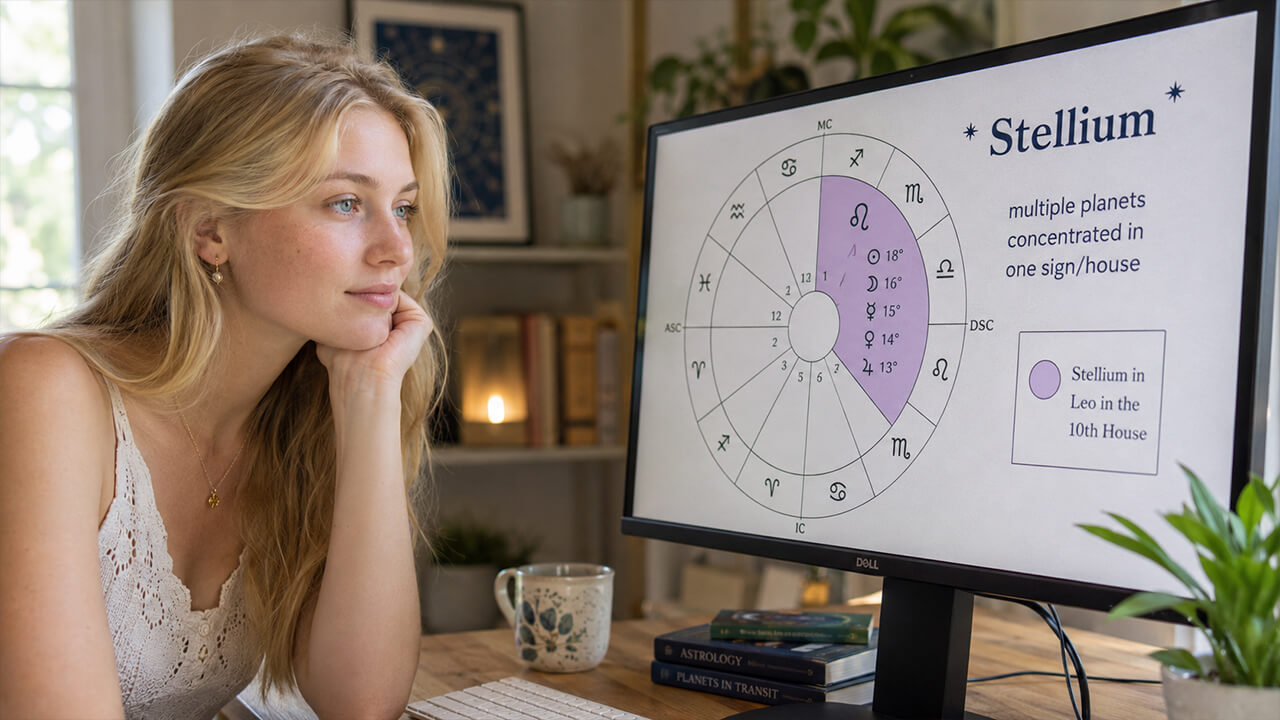
A stellium is a concentration of several planets in one zodiac sign or one house.
There is no single definition used by every astrologer.
Many astrologers call three or more planets in the same sign or house a stellium. Others require four planets. Some count the Sun and Moon. Others prefer to see at least three actual planets in addition to the luminaries.
In astrological language, the Sun and Moon are often included when people refer to the planets in a chart, even though they are not planets astronomically.
There is also disagreement about the lunar nodes, Chiron, asteroids, and angles such as the Ascendant or Midheaven.
These points can strengthen an existing concentration. They are less commonly used to create a stellium by themselves.
A chart containing the Sun, Mercury, and Venus in one sign creates another point of discussion.
Mercury and Venus remain relatively close to the Sun from Earth’s perspective, so this combination is not especially rare. Some astrologers still call it a stellium. Others look for an additional planet, such as Mars, Jupiter, or Saturn, before treating the cluster as unusually concentrated.
The label matters less than the structure.
Three closely connected planetary functions can shape a recognizable pattern, even when an astrologer chooses another term for the grouping.
Orb also matters.
Planets spread across nearly thirty degrees of one sign share the sign’s style, but they may not be forming close conjunctions with one another. Planets within a few degrees usually operate with greater intensity because their functions are directly combined.
Consider a Gemini concentration involving the Sun at 3 degrees, Mercury at 7 degrees, and Venus at 26 degrees.
All three planets are in Gemini. Thought, identity, and relationship values are expressed through curiosity, language, exchange, and changing perspectives.
The Sun and Mercury are also closely conjunct. Identity and thinking may be difficult to separate. The person can experience an opinion as something deeply personal.
Venus is farther away. It shares the sign, but it may operate with more independence.
Now consider the Sun, Mercury, Venus, and Mars all placed between 10 and 16 degrees of Gemini.
The concentration becomes tighter.
Self-expression, thought, attraction, desire, and action are being pushed through the same narrow part of the chart. Conversation can become the route through which the person seeks closeness, starts conflict, creates opportunities, and decides what they want.
This is why counting planets is only the beginning.
A useful stellium reading also considers distance, conjunctions, sign, house, planetary condition, rulership, and aspects from the rest of the chart.
Why a Stellium Feels Louder Than a Single Placement
A planet describes a particular function.
The Sun concerns identity, vitality, authorship, and direction.
The Moon describes emotional habits, instinct, memory, and safety.
Mercury handles thought, language, and information.
Venus concerns attraction, affection, pleasure, and value.
Mars describes action, desire, anger, and assertion.
When several of these functions occupy the same sign, they begin using a similar method.
A Scorpio stellium may process several parts of life through privacy, emotional intensity, trust, observation, and an awareness of what has not been said.
The person may think deeply before speaking because Mercury is in Scorpio. They may approach affection cautiously because Venus is there. Mars in Scorpio may pursue goals with persistence and a strong need to retain control over timing.
These are different functions.
They keep arriving through the same door.
That repetition makes the sign easier to recognize in everyday life.
Someone with one planet in Aquarius may express Aquarian qualities mainly through that planet. If it is Mercury, the person may think independently or prefer ideas that challenge convention.
A person with the Sun, Moon, Mercury, and Venus in Aquarius may experience identity, emotional regulation, conversation, and relationships through the need for space, perspective, independence, or connection with a larger group.
The sign becomes harder to set aside because several needs point in the same direction.
This concentration can create ability.
A Virgo stellium may support detailed observation, editing, classification, technical skill, and the patience to improve something through repeated small corrections.
A Leo stellium may produce creative ownership, confidence in presentation, leadership, or a strong sense of what deserves visible expression.
A Pisces stellium can heighten imagination, emotional receptivity, symbolism, compassion, and the ability to recognize what cannot be explained through facts alone.
The same concentration can create strain.
A Virgo stellium may keep finding another error after the work is already usable.
A Leo stellium may experience a lack of recognition as a deeper rejection of identity.
A Pisces stellium may absorb so much atmosphere that personal preference becomes difficult to separate from the needs of the room.
The problem is not that the sign is too strong.
The problem is that several parts of the person may rely on the same response.
Someone with a Libra stellium can be highly skilled at negotiation, tone, social balance, and understanding competing positions. When conflict becomes unavoidable, the person may continue searching for a solution that leaves nobody disappointed.
Thought says to compare.
Venus wants mutuality.
Mars tries to act without creating unnecessary damage.
The Sun wants to remain someone who behaves fairly.
One delayed decision now carries several psychological needs at once.
A stellium can therefore feel like both talent and pressure.
The person often has considerable experience with the area represented by the concentration. They may also have fewer internal alternatives when that familiar method stops working.
Sign Stelliums and House Stelliums Are Not the Same
A sign stellium describes several planetary functions operating through the same style.
A house stellium places several planetary functions in the same area of life.
The two can overlap, but they do not always.
Someone may have several planets in Capricorn divided between the fifth and sixth houses. The Capricorn style remains consistent, but the planets operate across creativity, romance, pleasure, work, health, and daily responsibility.
Another person may have a sixth-house stellium containing planets in two different signs. The shared focus is routine, labor, skill, service, coworkers, and the maintenance of everyday life. Each planet approaches that field through a different style.
This distinction changes the interpretation.
A Capricorn stellium tends to emphasize structure, responsibility, standards, endurance, authority, and results that can be maintained over time.
The house shows where that concentration becomes especially personal.
A Capricorn stellium in the fourth house may bring responsibility into family, home, property, privacy, and emotional foundations. The person may become the dependable one in the family. They may take home ownership seriously or feel that private safety must be built through control and preparation.
The same Capricorn stellium in the tenth house places the concentration closer to career, public responsibility, reputation, achievement, and authority.
Both charts contain strong Capricorn themes.
One carries them into the private foundation.
The other lives them more visibly through social direction.
A third-house stellium can make communication, learning, writing, siblings, local life, and everyday information unusually active.
This does not guarantee that the person is talkative.
Saturn in the third may speak carefully. Pluto may observe what other people avoid. Mercury may need constant exchange. The shared house keeps communication important, while each planet changes how that importance is experienced.
A seventh-house stellium brings attention toward partnership, commitment, negotiation, clients, contracts, and open conflict.
The person may learn a great deal through close relationships. That does not automatically mean relationships are easy or that the person should always be partnered.
Several parts of identity may become activated through the presence of another person.
The Sun in the seventh may seek purpose through partnership.
Mercury may need conversation and comparison.
Venus may place considerable value on reciprocity.
Saturn may make commitment serious, delayed, protective, or burdensome.
Calling the person relationship-oriented is accurate but incomplete.
The more useful question is what partnership is being asked to carry.
An eleventh-house stellium may focus life around friendship, communities, audiences, organizations, social causes, and plans for the future.
The person may be highly capable within networks while feeling unexpectedly uncertain in private intimacy.
A twelfth-house stellium can create a less visible concentration.
Several planetary functions may operate through solitude, retreat, unconscious habits, spirituality, institutions, private work, endings, or experiences the person cannot easily explain in public.
This does not make the planets weak.
It can make them harder for the person to recognize directly.
A twelfth-house Mars may experience anger privately before taking action. A twelfth-house Venus may protect affection or form attachments that are difficult to discuss. Mercury there may think extensively in solitude and struggle to translate an internal impression into ordinary language.
The house tells us where the stellium gathers.
The sign tells us how it behaves there.
Reading one without the other can turn a concentrated chart into a generic personality description.
How to Read a Stellium Without Letting It Take Over the Whole Chart
A stellium attracts attention because it is visually and symbolically concentrated.
The next step is to look outside it.
The rest of the chart shows how the concentration is supported, challenged, redirected, or given another method.
Begin with the planets involved.
A stellium containing the Sun, Mercury, and Venus has a different emphasis from one containing Mars, Saturn, and Pluto.
The first cluster connects identity, thought, affection, and values.
The second brings action, restraint, pressure, endurance, control, and deep change into close contact.
Both may be intense.
They do not create the same experience.
The outer planets also need care.
Uranus, Neptune, and Pluto remain in one sign for long periods. Many people born within the same generation share those placements.
An outer planet becomes more personally specific when it closely contacts the Sun, Moon, Mercury, Venus, Mars, an angle, or the ruler of an important house.
A person with Mercury, Venus, and Pluto tightly conjunct may experience conversation and attachment with considerable depth. They may notice hidden motives quickly, remember emotionally charged words, and struggle to treat certain exchanges as casual.
Someone with Saturn, Uranus, and Neptune in one sign may share a generational concentration with many peers. Its personal importance depends more heavily on the house, conjunctions to personal planets, and aspects to the rest of the chart.
The ruling planet of the stellium sign is especially important.
A Sagittarius stellium is ruled by Jupiter.
If Jupiter is in the second house, the concentration may eventually lead toward questions of money, self-worth, personal resources, or the need to create a life that supports freedom in practical terms.
A Scorpio stellium is traditionally ruled by Mars and, in modern astrology, also associated with Pluto.
The condition and location of Mars can show where the concentration finds a route for action. Pluto can add information about power, compulsion, and deep change.
A stellium does not stay contained inside one sign.
Its ruler carries the story elsewhere.
Aspects from planets outside the stellium can also provide contrast.
Imagine a person with a strong Gemini stellium and Saturn in Pisces forming squares to several planets in the cluster.
The Gemini concentration wants movement, information, comparison, and conversation.
Saturn in Pisces may introduce uncertainty about what can be clearly defined. The person may be highly verbal while fearing that words will fail to express the emotional reality.
They might collect more information when they actually need to tolerate ambiguity.
The Saturn squares do not cancel the stellium.
They show where the familiar method meets resistance.
Now consider an Aries stellium receiving a trine from Jupiter in Leo.
The chart may support visible initiative, confidence, creative risk, and the ability to recover quickly after taking action.
Ease can become its own blind spot.
The person may assume that acting first is always preferable because it has worked many times before. A different situation may require waiting, listening, or allowing someone else to set the pace.
The opposite sign deserves attention as well.
A stellium in Aries concentrates action, independence, and immediate response. Libra, the opposite sign, raises questions about mutuality, negotiation, and the effect of action on another person.
A Cancer stellium emphasizes protection, memory, attachment, and emotional security. Capricorn asks what structure, responsibility, and external limits are needed to support that private world.
A Virgo stellium notices what needs correction. Pisces asks what cannot be improved through analysis alone.
The opposite sign is not a missing quality that must be performed perfectly.
It shows the kind of experience that can keep the stellium from becoming a closed system.
Empty signs and houses also matter.
A chart may look heavily concentrated in one area, leaving another part almost untouched by natal planets. That does not remove the quieter area from life.
Someone with a tenth-house stellium still has a fourth house. Public ambition still rests on a private foundation. Career pressure eventually affects home, rest, family, and emotional security.
The empty house may become especially noticeable during major transits, relationships, or life events.
A concentrated chart does not produce a one-dimensional person.
It creates an uneven distribution of attention.
The stellium tells us where several functions gather naturally. The quieter parts of the chart show what may require more deliberate contact.
What the Concentration Is Asking You to Notice
A stellium is sometimes described as a special gift or a difficult burden.
It can become either, and often both.
The person may develop unusual competence because the same area receives repeated attention. They encounter related questions through several parts of life and gradually learn distinctions that other people do not need to make as often.
A sixth-house stellium may become highly skilled at routines, systems, service, health practices, technical work, or improving the conditions of daily labor.
The same person may have trouble leaving work unfinished, delegating responsibility, or recognizing when a system is asking too much from the body.
A fifth-house stellium can support creativity, teaching, performance, romance, work with children, or the courage to place something personal in public view.
It can also make recognition unusually important. A lukewarm response to one project may feel larger than the project itself because several planets are invested in expression.
An eighth-house stellium may develop considerable insight into trust, psychological complexity, shared money, grief, intimacy, and the hidden costs of dependence.
The person may also spend too much time monitoring what could be lost.
The useful question is not whether the stellium is good or bad.
It is whether the concentration has enough room to move.
Can the person use the ability without making every situation depend on it?
Can a Mercury-heavy stellium remain silent long enough to notice a feeling that has not yet become language?
Can a Saturn-heavy stellium accept support before responsibility becomes exhaustion?
Can a Venus-heavy stellium recognize the difference between preserving connection and avoiding disapproval?
Can a Mars-heavy stellium act without treating every delay as opposition?
A stellium becomes easier to live with when the person recognizes the familiar sequence early.
Someone with a Scorpio stellium may notice that uncertainty leads to observation, privacy, emotional testing, and a desire for stronger control.
Someone with an Aquarius stellium may respond through distance, analysis, principle, and the need to regain freedom of thought.
Someone with a Taurus stellium may seek predictability, practical evidence, bodily calm, and continuity before changing direction.
These responses are not errors.
They become restrictive when they remain the only available route.
Transits to a stellium can feel especially concentrated because one moving planet may contact several natal planets within a relatively short period.
Saturn crossing a stellium can bring an extended phase of definition, responsibility, delay, reduction, or structural change.
Jupiter can expand opportunity and confidence while enlarging whatever has already become excessive.
Uranus can disrupt several connected habits at once.
Pluto can make the person confront the power and cost attached to the entire concentration.
The experience may unfold in stages rather than as one event because the transiting planet reaches each natal planet separately.
A transit to Mercury may begin through information or a decision.
The later contact to Venus may bring money, values, or relationships into the same process.
A final contact to Mars can require action.
The transit is connected, but the person experiences several chapters.
This is another reason the stellium should not be reduced to a personality label.
It is a structure that becomes active through timing, relationships, and choices.
A chart with a stellium is not more powerful than a chart without one.
It is more concentrated in a particular place.
Some people build their lives around that concentration. Others spend years trying to escape it because the area has carried too much expectation.
The most revealing moments often occur when the person stops asking what the stellium proves about them and begins noticing what repeatedly receives their time, concern, effort, and emotional weight.
A stellium becomes most useful when it stops being a title and starts showing where the same part of life keeps asking for more room.

Sandy Tide Readings
Divination content designer based in Japan. I share astrology content and original divination content inspired by horoscopes, numerology, and planetary placements.
About Sandy Tide Readings ↗