In this article
People often start paying attention to transits when life feels different before they can explain why.
Work becomes heavier. A relationship conversation keeps returning. The motivation that carried a project for months suddenly disappears. Someone checks an astrology app and sees several colored lines crossing their birth chart.
The usual reaction is to search for the strongest phrase.
Saturn is testing you.
Pluto is transforming your life.
Jupiter is bringing opportunity.
Those descriptions are easy to remember. They can also make a transit sound like an outside force arriving with a fixed plan.
For example, someone learns that Saturn is moving across their natal Moon.
They read that this transit can feel lonely, emotionally restrictive, or demanding. A friend cancels dinner that week. Their family needs more practical help. They feel tired after work and begin treating every difficult feeling as evidence that Saturn has taken control of the year.
The transit may describe a period when emotional responsibilities feel harder to ignore.
It does not explain every canceled plan.
It cannot decide whether the person needs more solitude, better boundaries, practical support, or an honest conversation about how much they have been carrying.
The unnoticed burden appears when every event is interpreted through the transit before the event itself is examined. Astrology begins replacing context instead of helping someone understand it.
A transit is most useful when it identifies the part of life receiving pressure, movement, or renewed attention. It does not remove the person from the situation.
Before interpreting what a current planet is doing, the first place to begin is with the relationship between the sky now and the birth chart underneath it.
A Transit Compares the Current Sky With Your Birth Chart
An astrological transit is the position of a planet at a particular time compared with the positions in a natal chart.
The natal chart is based on the date, time, and place of birth. It records where the Sun, Moon, planets, angles, and houses were located at that moment.
Those natal positions remain fixed.
The planets in the sky continue moving.
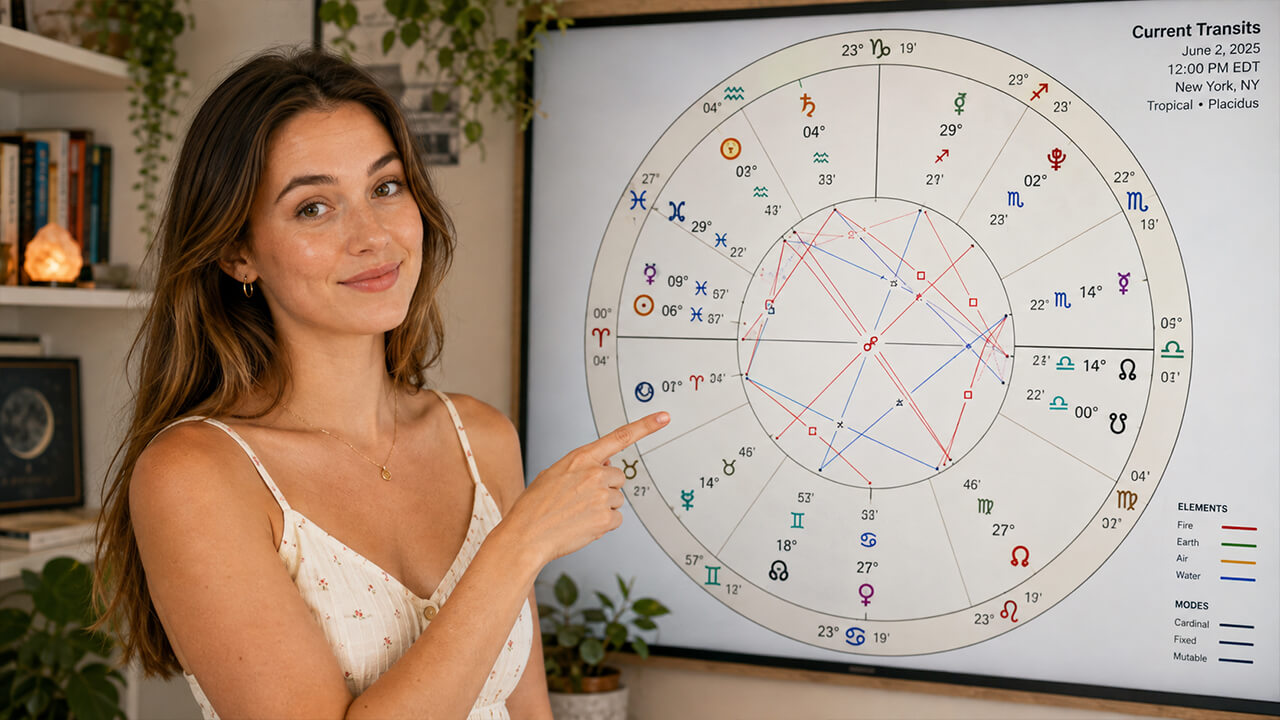
A transit chart places the current planets around the outside of the natal chart so their relationship can be examined.
Suppose someone has natal Venus at 15 degrees of Taurus.
When Mars reaches 15 degrees of Taurus, transiting Mars forms a conjunction with that natal Venus. When Saturn reaches 15 degrees of Aquarius, it forms a square. When Jupiter reaches 15 degrees of Virgo, it forms a trine.
The current planet supplies the movement.
The natal planet describes the part of the person being contacted.
Mars brings urgency, assertion, desire, conflict, or the need to act.
Natal Venus concerns affection, attraction, values, money, pleasure, and the way someone creates agreement.
A Mars transit to natal Venus can increase attraction or make a financial decision feel more urgent. It can bring a disagreement about what each person wants. It may also give someone enough directness to state a preference they have been softening for weeks.
The aspect helps describe how the two functions meet.
A conjunction concentrates them in the same place.
A square brings friction, pressure, and the need for adjustment.
An opposition places the issue across a relationship or competing position.
A trine allows the functions to cooperate more easily.
A sextile creates an opening that usually requires some participation before it becomes useful.
No single aspect is entirely good or bad.
A trine can make an ability easier to use. It can also allow a familiar habit to continue without being questioned.
A square can feel uncomfortable. It often makes the existing problem difficult to avoid.
The houses show where the transit is becoming visible.
Transiting Jupiter through the second house can increase attention to income, pricing, possessions, and personal resources. It may coincide with growth. It can also increase spending or make someone more willing to take a financial risk.
Transiting Saturn through the seventh house can bring greater seriousness to partnership, contracts, and one-to-one commitments. Some relationships become more defined. Others reveal that the existing agreement cannot carry the responsibility being placed on it.
Transiting Uranus through the tenth house can alter career direction, public identity, or the person’s relationship with authority. The visible change may be dramatic. It may also begin as a quiet refusal to keep performing a role that has become too narrow.
The sign describes how the planet operates.
The house describes where the issue is taking place.
The natal planet or angle describes what personal function is being contacted.
The aspect describes the kind of interaction occurring between them.
A useful transit reading keeps all four parts connected.
“Saturn is in Aries” is a collective statement. Everyone alive shares that sky.
“Transiting Saturn in Aries is opposing your natal Mercury in Libra in the third house” is personal. It connects the current planet with a specific part of the natal chart.
That difference explains why two people can live through the same month and experience it very differently.
Current Planets Do Not Affect Every Person in the Same Way
General horoscopes usually interpret transits through the Sun sign or rising sign.
They can describe the broad area receiving attention. They cannot show every contact being made to an individual natal chart.
A Jupiter transit may be described as fortunate.
For one person, Jupiter is crossing the Midheaven and expanding professional visibility.
For another, it is opposing natal Saturn and making an existing conflict between growth and caution harder to ignore.
A third person may have no close Jupiter aspects at all. The transit remains part of the background rather than becoming a major personal event.
The closeness of an aspect matters.
Astrologers use an orb, which is the allowable distance between two positions.
A planet at 14 degrees may already be treated as contacting a natal planet at 15 degrees. The exact orb depends on the planets, the aspect, and the astrologer’s method.
The transit usually becomes more noticeable as it approaches exactness.
The issue may peak near the exact degree.
It often continues while the planet moves away.
Retrograde motion can extend the process.
A slower planet may cross the same natal position three times: once moving forward, again while retrograde, and a final time after turning direct.
The first pass often introduces the subject.
The retrograde pass returns attention to what was not understood or completed.
The final pass can coincide with a decision, consequence, or clearer recognition of what the period has required.
That sequence is not guaranteed.
It is a useful way to observe development without forcing each pass into a dramatic event.
Consider a Saturn square to natal Venus.
During the first pass, a person may notice that a relationship is asking for more time and responsibility than expected.
During the retrograde pass, an old agreement returns for discussion. Money, exclusivity, distance, or emotional availability may need clearer terms.
During the final pass, the couple may commit to a more realistic structure. They may also recognize that affection alone cannot support the relationship.
The transit does not decide which result occurs.
It describes the pressure around Venus subjects and Saturn conditions.
The natal chart changes the expression further.
Someone with natal Venus already making a strong Saturn aspect may recognize the terrain. Commitment, caution, loyalty, scarcity, or fear of rejection may have been part of their relationship pattern for years.
The transit brings that pattern into a period when it becomes harder to leave automatic.
Another person may experience the same transit as unfamiliar restraint. They are used to following attraction quickly and now encounter a situation that requires patience.
The sky is the same.
The natal structure receiving it is different.
Life circumstances matter too.
A Saturn transit through the fourth house can involve home, family, property, private life, or emotional foundations.
For one person, this coincides with caring for an aging parent.
Another signs a mortgage.
Someone else lives alone for the first time and realizes how much family tension had been shaping their daily mood.
The transit does not produce identical events.
It gathers attention around a related field of experience.
That is why a responsible reading needs more than a list of keywords.
Fast Transits Describe the Weather of a Day, While Slow Transits Shape Longer Periods
The speed of the transiting planet changes how long its influence remains noticeable.
The Moon moves quickly.
It travels through the zodiac in about a month and changes signs every few days. A lunar transit can describe a temporary mood, a short emotional reaction, or the timing of an ordinary event.
The Moon crossing natal Mars can coincide with irritation, physical restlessness, or a faster emotional response. The feeling may be real. It does not need to become a conclusion about the entire relationship or workplace.
Mercury, Venus, and Mars also move quickly compared with the outer planets.
Their transits often describe conversations, social contact, attraction, purchases, decisions, motivation, and short periods of activity.
Transiting Mercury conjunct natal Saturn may coincide with a serious conversation, concentrated work, delayed information, or the need to choose words carefully.
Venus crossing the Ascendant can increase social ease, attention to appearance, or the desire to create a more pleasant environment.
Mars crossing the Midheaven can bring professional drive, conflict with authority, a visible deadline, or impatience with a stalled career matter.
These transits often act as triggers.
A fast planet can activate a longer transit already underway.
Someone may be living through Pluto square natal Moon for many months. The deeper period concerns emotional control, family history, vulnerability, or the need to stop organizing life around an old survival response.
A Mars transit to the same Moon can bring a specific argument or decision that makes the larger Pluto process visible.
Mars did not create the entire issue.
It gave the issue a day and a form.
Jupiter and Saturn move more slowly.
Their transits often last for months, especially when retrograde motion creates repeated contacts.
Jupiter expands, connects, increases, and draws attention toward possibility. Expansion is not always comfortable.
A larger opportunity requires more capacity.
Increased income can arrive with increased responsibility.
Greater visibility can reveal that the current system was designed for a smaller audience.
Saturn concerns limits, structure, time, responsibility, consequence, and durability.
A Saturn transit can feel restrictive when an existing arrangement cannot continue without discipline or revision.
It can also support work that becomes stronger through consistency.
Saturn does not simply take things away.
It asks what can remain standing under real conditions.
Uranus, Neptune, and Pluto move slowly enough to describe longer developmental periods.
Uranus disrupts patterns that have become too fixed. It increases the need for space, experimentation, or a more honest form of independence.
Neptune softens boundaries and heightens imagination, longing, uncertainty, compassion, and projection. It can inspire. It can also make facts difficult to separate from hope or fear.
Pluto intensifies issues involving power, survival, control, loss, secrecy, and deep psychological change. Its transits often expose what cannot be repaired through surface adjustment.
These planets can remain within range of a natal position for a long time.
Their effects are rarely one event.
The experience unfolds through several decisions, relationships, realizations, and changes in behavior.
A person may look back and identify one day as the turning point. The transit usually describes the larger period that made the turning point possible.
Several transits also operate at once.
A person can have Saturn opposing natal Mercury while Jupiter trines the Sun and Venus moves through the seventh house.
The period may include a demanding contract discussion, growing confidence, and greater relationship support at the same time.
Astrology does not require life to express one clean theme.
People often experience opportunity and pressure together.
A chart with only favorable language would be incomplete.
A chart interpreted only through difficulty would be equally misleading.
A Transit Shows Timing and Pressure, Not a Finished Outcome
Transits are often used for prediction because they add time to the natal chart.
They show when a particular theme is receiving more attention.
That does not turn them into a schedule of unavoidable events.
A transit to the seventh house can make relationships central.
It cannot guarantee marriage or separation.
A Jupiter transit to the second house can expand financial activity.
It cannot guarantee profit.
A Pluto transit to the Midheaven can coincide with a major career transformation.
It cannot name the new profession without considering the natal chart, the person’s choices, and the actual opportunities available.
The most useful question is not “What will this planet do to me?”
A better question is “Which part of my life is under enough pressure that my usual response may no longer work?”
That approach keeps the transit connected with lived experience.
Suppose Uranus is conjunct someone’s natal Venus.
They may suddenly feel attracted to a person outside their usual pattern.
Their income may become less predictable.
A long relationship may need more room and a different agreement.
Their taste, values, or creative direction may change quickly.
The transit does not automatically mean betrayal, separation, or financial loss.
It describes disruption and renewed freedom within Venus-related subjects.
The response determines much of the result.
A person can use the period to speak honestly about a need that has been hidden.
They can also chase novelty without considering the effect on other people.
Both actions belong to the same symbolic field.
Only one reflects greater awareness.
Transits should not be used to avoid ordinary evidence.
A difficult Mars transit does not explain repeated cruelty.
A Neptune transit does not make dishonesty acceptable.
A Saturn transit does not require someone to stay in an unhealthy job to prove endurance.
Astrology can show why a subject feels unusually active.
The real situation still needs to be examined on its own terms.
It also helps to notice when the transit confirms something the person already knows.
The job has been unsustainable for months.
The relationship needs a clearer agreement.
The financial system depends on income that is no longer reliable.
The person has delayed the decision because no option feels painless.
A transit may coincide with the moment that delay becomes harder to maintain.
That does not make the decision less personal.
It makes the timing easier to recognize.
Sometimes a transit passes without a visible event.
The change remains internal.
A person stops seeking approval from the same authority figure.
They become less willing to explain a boundary repeatedly.
An old ambition loses its emotional hold.
The outside of life looks similar, but the meaning of the situation has changed.
That still belongs to the transit.
Astrology is not limited to events other people can see.
A useful transit reading leaves the person with more context, not less choice.
It identifies the current planet.
It shows the natal point being contacted.
It considers the aspect, house, sign, duration, and the rest of the chart.
Then it returns to the actual life.
What has already started changing?
Which pressure keeps repeating?
What requires a clearer decision?
Where is the person relying on a response that once protected them but no longer fits the present situation?
The transit does not provide a finished answer.
It marks the period in which a particular question has become difficult to ignore.

Sandy Tide Readings
Divination content designer based in Japan. I share astrology content and original divination content inspired by horoscopes, numerology, and planetary placements.
About Sandy Tide Readings ↗